
Why the Gold Coast Has Become the World’s Most Compelling Luxury Real Estate Destination
The Lifestyle Pull: What Makes This Coastline Different
Costa Rica’s Pacific Gold Coast does something no other tropical market quite manages: it delivers world-class luxury alongside a functioning, stable country. You are not choosing between beauty and convenience. Guanacaste’s Papagayo Peninsula sits 25 minutes from a modern international airport with direct flights from major U.S. cities. Tamarindo has a bilingual international school, fiber-optic internet, and a farmers’ market. Manuel Antonio pairs a national park boundary with five-star resort infrastructure.
The lifestyle itself draws a particular kind of buyer, one who wants the ocean at the doorstep but also wants a reliable cardiologist, a good espresso, and a Pilates studio within reasonable distance. The Gold Coast has all of that now, layered on top of 300 days of sunshine, humpback whales offshore, and a biodiversity density that genuinely has no rival at this price point anywhere in the tropics.
From Niche Escape to Mainstream Investment: How Two Decades of Market Evolution Created Today’s Opportunity
The buyers arriving today are inheriting infrastructure they did not have to build. Two decades ago, the roads from Liberia to the coast were unpaved, the grid was unreliable, and “luxury” here meant something apologetic. The early buyers, adventurous, patient, and often visionary, watched the government pave Highway 21, watched the Four Seasons anchor Papagayo, and watched property values track infrastructure investment closely upward.
What that history created is a market with legitimate depth. Resales are liquid by regional standards. Valuations are anchored to comparable sales data, not speculation. The buyer pool is international and growing, drawn by the same set of pull factors that have become self-reinforcing: infrastructure attracts buyers, buyers attract services, services attract more buyers. You are entering a market that has already proven its thesis.
The Dollar-Denominated Advantage: Why Global Uncertainty Makes a Hard Asset on the Gold Coast More Attractive Right Now
Costa Rica prices, negotiates, and closes luxury real estate transactions in U.S. dollars. That single fact does more practical work for a foreign buyer than most people realize. Your purchase price does not move with the colon. Your rental income gets deposited in dollars. Your property’s appreciation is benchmarked in dollars. In a global environment where currencies, equities, and bond markets are all repricing simultaneously, owning a hard asset in a dollar-denominated market with strong rental demand is a structural hedge, not just a lifestyle choice.
Costa Rica also ranks as one of the most politically stable countries in Latin America, with no standing army since 1948, consistent democratic governance, and a rule of law that extends meaningful property rights to foreigners. Those are not marketing talking points. They are the legal and institutional foundations on which your investment actually rests.
Is Costa Rica a Good Investment for Foreign Real Estate Buyers?
For buyers who do their homework and choose their location and property type deliberately, the answer has been consistently yes. The market has rewarded well-positioned properties with appreciation through multiple global cycles, including 2008 and the pandemic years. The rental market on the Gold Coast has expanded as tourism infrastructure has matured, creating genuine short-term yield potential alongside long-term appreciation. Relatively low property taxes, no capital gains tax on residential property held long-term, and strong foreign ownership protections make the investment structure genuinely favorable compared to most markets a buyer of this caliber would consider.
The honest caveat is this: the difference between a rewarding investment and a frustrating one usually has less to do with the market and more to do with what happens after the purchase. We will spend significant time on that distinction throughout this guide.
What Luxury Actually Looks Like Here: Property Types, Locations, and Price Ranges Across the Gold Coast
Beachfront Estates and Oceanfront Villas: The Flagship Asset Class
Beachfront property on the Gold Coast commands a premium that tracks global supply logic: there is not much of it, international demand for it grows steadily, and it generates the strongest short-term rental returns of any property type in the market. A well-appointed oceanfront villa in a sought-after location can generate 60 to 75 nights of bookings per year at nightly rates that would surprise most first-time buyers.
Tamarindo and the Guanacaste Coast: Established Infrastructure, International Community
Tamarindo is the Gold Coast’s most mature market. The town has real walkability, a surf culture that attracts a younger affluent demographic, and a restaurant and nightlife scene that functions year-round. Luxury villas here range from $800,000 for a well-positioned three-bedroom to $3 million or more for a genuine oceanfront estate. Rental demand is strong and consistent, buoyed by a deep pool of repeat visitors who know the destination well.
Papagayo Peninsula: Ultra-Luxury, Gated, and Resort-Integrated
The Papagayo Peninsula is the closest the Gold Coast gets to a trophy address. The peninsula hosts the Four Seasons and several private gated communities with resort amenities including beach clubs, marinas, and golf. Prices reflect that positioning: entry-level luxury here starts around $1.5 million and scales to $10 million or more for estate-scale beachfront. The buyer profile skews toward high-net-worth purchasers who want maximum amenity, maximum security, and zero management friction.
Ocean-View Hillside Homes: Maximum Views, Maximum Privacy
Hillside properties offer the Gold Coast’s most compelling value proposition: panoramic Pacific views, natural airflow that reduces cooling costs, and genuine privacy, often at prices 20 to 40 percent below comparable beachfront. The trade-off is that you are typically a 5- to 15-minute drive from the water. For buyers who want a primary or semi-primary residence rather than a pure rental asset, hillside living often delivers more livability per dollar.
Dominical and Uvita: The Emerging South Pacific Corridor
The South Pacific corridor from Dominical to Uvita is the market’s most exciting emerging story. Properties here sit where the rainforest literally meets the Pacific, with whale-tail beach views that have become iconic in travel media. Infrastructure is catching up faster than most buyers realize, and prices still carry a meaningful discount to Guanacaste, which means buyers entering now are positioned ahead of the curve.
Manuel Antonio: Rainforest Meets Pacific in a Perennially Sought-After Address
Manuel Antonio has been an international tourism destination for decades, anchored by one of the most visited national parks in Central America. Luxury hillside homes here offer jungle canopy views, resident monkey and sloth sightings, and access to a well-developed service economy. Supply is constrained by the park boundary, which provides a structural floor under values. Prices for high-spec luxury homes run $900,000 to $3 million or more depending on view quality and finish level.
Golf Course and Resort-Community Properties: Turnkey Luxury With Built-In Amenities
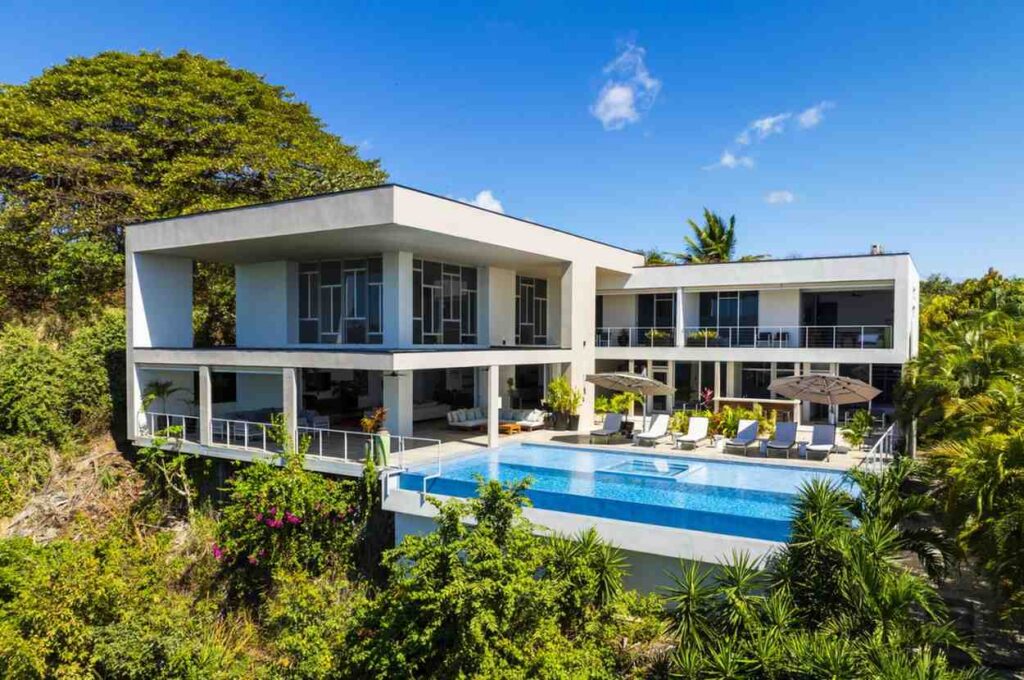
Resort community properties, homes inside gated developments with shared golf, beach club, and concierge services, solve the management complexity problem more elegantly than almost any other property type. The HOA handles common area maintenance, security, and often connects owners to in-house rental programs. For absentee owners who want genuinely passive ownership, a resort community home is worth serious consideration even if the sticker price runs 15 to 20 percent above an equivalent standalone property.
How Much Does Luxury Real Estate Cost in Costa Rica’s Prime Locations?
Entry-level luxury on the Gold Coast, a well-finished three-bedroom home with pool and ocean views, starts around $600,000 to $800,000 in emerging markets and $900,000 to $1.2 million in established ones. Mid-tier luxury runs $1.5 million to $3.5 million. True trophy properties, beachfront estates, Papagayo Peninsula homes, and architect-designed hillside compounds, range from $4 million to $12 million and occasionally beyond.
Gold Coast Neighborhood Comparison
| Neighborhood | Property Types | Typical Price Range | Vacation Rental Potential | Lifestyle Profile | Ideal Buyer |
|---|---|---|---|---|---|
| Tamarindo / Flamingo | Beachfront villas, condo-hotels, hillside homes | $800K – $3M+ | High; strong year-round demand | Walkable, active, social; international expat community | Buyers wanting rental income plus personal use |
| Papagayo Peninsula | Gated estate homes, resort residences, marina villas | $1.5M – $10M+ | Very high for resort-integrated properties | Ultra-private, resort-amenity-rich; Four Seasons adjacency | High-net-worth buyers prioritizing prestige and turnkey amenity |
| Manuel Antonio | Hillside jungle-view homes, boutique villa compounds | $900K – $3.5M | High; national park drives year-round tourism | Lush, wildlife-rich, quieter pace; well-developed services | Nature-oriented buyers; those wanting constrained supply and long-term stability |
| Dominical / Uvita | Rainforest-edge hillside homes, small estates | $500K – $2.5M | Moderate to high; growing rapidly | Remote, dramatic scenery; whale-tail beach backdrop | Appreciation-focused buyers seeking value in an emerging corridor |
| Nosara / Sámara | Wellness-oriented villas, surf-community homes | $700K – $2.5M | High during surf and yoga season | Bohemian luxury; wellness, surf, and intentional living | Wellness and lifestyle buyers seeking a values-aligned community |
The price ranges above reflect mid-to-high-spec properties as of 2025 and will vary based on lot size, finish quality, view angle, and distance to water. Off-market and pre-construction inventory can fall outside these ranges in either direction. A trusted local advisor helps you read any specific listing against current comparable sales, and that context is exactly what separates a confident offer from an uninformed one.
The Legal Roadmap: How Foreign Buyers Secure Clean, Protected Title in Costa Rica
What Are the Legal Requirements for Foreigners Buying Property in Costa Rica?
Foreigners have the same property ownership rights as Costa Rican citizens for fee simple titled land. You do not need residency to purchase. You do not need a local partner or co-signer. You can hold property in your personal name, through a Costa Rican corporation (Sociedad Anónima or S.R.L.), or through a foreign holding entity. Each structure carries different liability, tax, and estate-planning implications, and the right choice depends on your specific situation. Work through this decision with a qualified Costa Rican attorney before signing anything.
The legal requirements are genuinely accessible. What creates complexity is not the law itself but the landscape of properties that have title irregularities, encroachments, municipal debt, or Maritime Zone complications. Due diligence, done properly, catches all of those before you are exposed to them.
Fee Simple vs. Leasehold: Understanding the Critical Difference Before You Make an Offer
Fee Simple Title and the Registro Nacional: Your Strongest Legal Protection
Fee simple title means you own the land outright, recorded in Costa Rica’s Registro Nacional (Public Registry). Your ownership is searchable, verifiable, and protected by the same legal framework that protects any citizen’s property. This is the title structure you want for any luxury purchase. Your attorney confirms it through a formal title search, and the result either clears or flags the property before you commit a dollar.
Maritime Zone Law (Zona Marítimo Terrestre): What It Means for Beachfront Properties
The Maritime Zone Law is the single legal concept that surprises foreign buyers most often. The first 50 meters from the high tide line is public domain; no one can own it outright. The next 150 meters is the Zona Marítimo Terrestre, and within that zone, property is held through a concession granted by the municipality, not through fee simple title. That concession is a leasehold-style right, not outright ownership, and its conditions, including renewal rights, transferability, and duration, vary by municipality and concession document.
This does not make beachfront property in the Maritime Zone a bad investment. Thousands of valuable, well-established properties sit inside it. But the terms of your concession matter enormously and require specialized legal review. A property advertised as “beachfront” may sit in the Maritime Zone, outside it, or span both, and each scenario carries different legal implications. Your attorney reads the concession documents while your real estate partner helps you understand what those terms mean for your use and your eventual resale.
How the Purchase Process Works: A Step-by-Step Walk From Offer to Title Transfer
The Role of the Notary-Attorney: Why This Is Not a Standard American Closing
Costa Rica does not use title companies or escrow attorneys the way the U.S. does. The transaction is executed by a notary-attorney (notario público), a licensed professional who holds specific government authority to formalize the transfer deed, pay the applicable transfer taxes and fees, and register the transaction in the Registro Nacional. This is one person doing the work that multiple parties handle in a U.S. transaction. Your notary-attorney must be someone you trust and, ideally, someone your real estate partner has vetted through direct professional experience.
Title Search, Due Diligence, and Escrow: Three Layers That Protect Your Investment
The three protective layers work in sequence.
- Title search: Your attorney pulls the full chain of title from the Registro Nacional, confirms there are no liens, mortgages, encumbrances, or conflicting claims, and verifies the legal description matches the physical property.
- Due diligence: Beyond title, this covers municipal debt verification, utility accounts, survey confirmation, Maritime Zone status where applicable, HOA standing, and any permits or construction legality questions.
- Escrow: Funds are held by a licensed escrow company, often a Costa Rican law firm or specialized escrow provider, until all conditions are met and the title transfers cleanly. Wiring money directly to a seller or developer before closing is a practice no experienced buyer repeats.
Can Foreigners Get a Mortgage to Buy Property in Costa Rica?
Local bank financing is available to foreign buyers, but it is more restrictive and more expensive than what most buyers are accustomed to at home. Costa Rican banks typically lend 50 to 70 percent of appraised value at interest rates that have generally ranged between 7 and 9 percent in U.S. dollar terms, with loan terms shorter than the 30-year mortgages common in the United States. Documentation requirements are substantial and the approval timeline is long.
In practice, the majority of luxury purchases on the Gold Coast are cash transactions. Buyers who need financing often use home equity or portfolio-backed lending from their home country, where rates and terms are more favorable. Developer financing is sometimes available on new construction or pre-construction projects and can offer more flexible terms than a local bank.
Property Taxes, HOA Fees, and the True Cost of Ownership Beyond the Purchase Price
How Property Taxes Work in Costa Rica: The Impuesto Sobre Bienes Inmuebles Explained
Costa Rica’s annual property tax, the impuesto sobre bienes inmuebles, is assessed at 0.25 percent of the registered value of the property. On a $1.5 million home, that is approximately $3,750 per year. The registered value is set by the municipality based on a self-declaration process updated periodically, and in many cases the registered value lags behind market value. Even at full market value, the effective tax rate is low relative to most U.S. states or European countries.
Properties registered to a corporation are subject to an additional corporate property tax, currently around 0.25 percent of the registered property value per year. Your attorney structures the holding entity to minimize total tax exposure.
HOA and COA Fees: What They Cover and How to Evaluate Them Before You Buy
HOA fees in luxury Costa Rican communities typically cover security, road maintenance, common area landscaping, pool and gym upkeep, and sometimes beach club access. In resort-integrated communities, fees may also include concierge services and managed rental program access. Monthly HOA fees for luxury properties generally range from $300 to $1,500 depending on the development and what is included.
Before you sign, ask for 12 months of HOA financial statements, the reserve fund balance, and the board’s capital improvement plan. A well-run HOA with a healthy reserve is an asset. An underfunded HOA with deferred maintenance is a liability that will eventually show up as a special assessment.
The combined annual cost of property tax plus HOA fees on a $1.5 million luxury home in a managed community typically runs $8,000 to $22,000 per year depending on the development. Add insurance, routine maintenance, and property management fees, and the true annual carry cost for an absentee-owned luxury property runs approximately 2 to 4 percent of purchase price. That is a meaningful number, and it is also the honest number that lets you model your investment returns accurately from day one.
Vacation Rental ROI: What Realistic Returns Look Like on the Gold Coast
What Is the Average ROI on Vacation Rental Properties in Costa Rica?
Well-positioned luxury vacation rentals on the Gold Coast typically generate gross rental yields between 6 and 12 percent annually, before management fees and operating costs. Net yields, what actually lands in your account after all expenses, generally run 4 to 8 percent depending on the property, its location, and how well it is managed. Those numbers compare favorably to most U.S. vacation rental markets, and they sit on top of appreciation that has historically been strong in established Gold Coast corridors.
The range is wide because performance is not uniform. A beachfront villa in Tamarindo with professional management, quality photography, and smart channel distribution will outperform a hillside home in the same town that sits on one listing platform with mediocre photos. The market rewards execution, not just location.
The Occupancy Rate Equation: What Drives Performance in the Gold Coast Market
High season on the Gold Coast runs roughly mid-November through April, driven by dry weather and the North American and European winter escape calendar. Top-performing properties achieve strong occupancy rates during those months. Shoulder season, May through mid-July and again in October, still generates meaningful bookings, particularly from surf travelers, wellness retreats, and families using school holidays. The Green Season from roughly August through October is quieter but not dead, and properties that are priced and marketed for that period capture incremental revenue that others leave on the table.
What separates the properties that hit 60-plus nights of total annual bookings from those stuck at 30? Professional photography, accurate and compelling listing copy, rapid guest response times, competitive pricing calibrated by season, and a management team that actively solicits reviews. None of that happens automatically. It requires someone with local market knowledge making active decisions on your behalf every week.
Long-Term Rental vs. Vacation Rental: Choosing the Right Strategy for Your Property
A long-term rental, typically a 12-month lease to an expat, a remote worker, or a relocating family, offers predictability that vacation rental income does not. You know exactly what you will receive each month, you do not manage guest turnover, and the property experiences less wear. Monthly rents for luxury homes in established Gold Coast communities run $3,500 to $10,000 depending on size, location, and finish level.
Vacation rental upside is higher, but so is management intensity. For most foreign owners who want to use the property personally a few weeks per year, vacation rental is the stronger financial choice, provided the property type and location support it. Beachfront villas and resort-community homes near major tourist corridors are built for vacation rental economics. A hillside home in a quieter area with limited tourism infrastructure may actually perform better as a long-term rental.
The decision is not permanent. Many owners start with one strategy, refine based on actual results, and adjust. What matters is choosing intentionally from the start rather than defaulting to whichever path feels easier.
An Illustrative Ownership Scenario: From Purchase Through Year-Three Rental Performance
Consider a $1.2 million ocean-view villa in Tamarindo: three bedrooms, a pool, and a professionally designed interior. Closing costs and initial furnishing bring the all-in entry cost to approximately $1.26 million.
In year one, the property generates $72,000 in gross rental revenue across 58 nights at an average nightly rate of $1,240. Property management fees at 20 percent reduce that to $57,600. Operating costs, including utilities, supplies, maintenance, insurance, HOA fees, and property tax, run approximately $24,000 for the year. Net income comes to roughly $33,600, a modest net yield in the first year while the property builds its review history and repeat guest base.
By year three, with a maturing listing profile and a growing repeat guest segment, occupancy climbs to 72 nights and the average nightly rate increases as the property earns five-star review density. Gross revenue reaches approximately $97,200. After management fees and operating costs, net income approaches $52,000. Add estimated property value appreciation over three years at a conservative annual rate, and the total return picture becomes considerably more compelling.
These numbers are illustrative, not guaranteed. But they are grounded in the actual performance range we see across the Gold Coast portfolio, and they give you an honest framework to stress-test any specific property you are considering.
Separating Honest Expectations From Hype: What Foreign Buyers Should Know About Investment ROI
The most common mistake buyers make is modeling for peak-season revenue only, then expressing surprise when the annual average disappoints. The second most common mistake is underestimating management fees, maintenance costs, and the year-one ramp-up period before a property gains market traction.
Realistic expectations look like this: years one and two are investment years where net yields are modest and the property is building its market position. Years three through five are where the return thesis proves out, assuming strong management and a quality asset. Long-term appreciation is the wealth-building engine while rental income covers carry costs and then generates meaningful cash flow as the property matures. Buyers who understand that sequence enter with patience and exit with results.
The Hidden Challenge Nobody Tells You About: Managing Luxury Property From Abroad
Why Absentee Ownership Without Local Infrastructure Erodes Both Asset Value and Peace of Mind
Owning a luxury property in paradise while living in another country sounds straightforward until a rainstorm exposes a roof issue at 2 a.m. on a Saturday, a guest checks in to find the pool pump non-functional, or a contractor disappears mid-renovation. These are not hypothetical scenarios. They are the normal reality of tropical property ownership, and they require someone on the ground with the authority, the relationships, and the judgment to act immediately.
Without that infrastructure, small problems become expensive ones. A slow leak ignored for two months becomes a mold remediation project. A guest complaint left unaddressed becomes a one-star review that costs you future bookings. An HOA meeting missed becomes a surprise special assessment you could have influenced. The asset does not manage itself, and distance does not reduce the need for management. It increases it.
What Property Management Services Are Available for Absentee Luxury Homeowners?
Full-service property management for luxury absentee owners covers two distinct tracks: the rental operation and the property itself.
On the rental side, a full-service manager handles listing creation and optimization, pricing strategy, booking management, guest communication, check-in and check-out coordination, housekeeping supervision, and review management. On the property side, the manager conducts regular inspections, coordinates routine maintenance, manages vendor relationships, responds to emergencies, tracks utility accounts, and flags issues before they escalate.
The best property managers handle both tracks under one roof, because the two are inseparable. A property that is not maintained to a high standard fails its guests. A property with guest problems creates maintenance issues. The integration of vacation rental management and physical property oversight is what separates a genuinely managed asset from one that is simply listed on Airbnb or VRBO and left to fend for itself.
HOA and COA Coordination: The Invisible Work That Protects Your Investment
Your HOA or Community Owners Association governs a significant portion of the shared experience that determines your property’s value and your guests’ satisfaction. Gate access, common area conditions, pool quality, road maintenance, security protocols: all of it flows through HOA decisions that happen whether or not you are paying attention.
Absentee owners who are not actively represented in HOA communications often miss fee changes, special assessments, rule modifications, or maintenance deferrals until the consequences are already in motion. A local property manager who attends HOA meetings, reviews meeting minutes, and flags relevant decisions to you keeps you informed and positioned to respond. That is work that rarely gets mentioned, but it protects your investment in ways that are difficult to quantify until something goes wrong.
Vacation Rental Marketing, Guest Vetting, and Channel Management From 3,000 Miles Away
A luxury property in Costa Rica competes globally for bookings. Getting found, chosen, and reviewed well requires active channel management: distributing your property across the right platforms, optimizing listing content seasonally, adjusting pricing based on real-time demand signals, and responding to inquiries quickly enough to convert them before the guest books elsewhere.
Guest vetting matters at the luxury level. A property priced at $1,200 a night needs guests who treat it that way. A property manager with experience in luxury vacation rentals screens for fit, communicates expectations clearly before arrival, and handles the occasional difficult situation without pulling you out of your workday to adjudicate a dispute about the pool heater settings.
Maintenance, Emergency Response, and Vendor Relationships: Why Local Trust Networks Matter
Tropical climates are hard on buildings. Salt air, humidity, and seasonal rain create maintenance demands that a temperate-climate homeowner genuinely underestimates. Air conditioning systems need quarterly service. Pools require weekly attention. Roofs, outdoor furniture, and exterior paint have shorter cycles than you are probably used to. Wood elements and hardware corrode faster than you expect.
Getting reliable, fairly priced work done in a foreign country requires relationships built over years. A property manager with a trusted vendor network gets the right contractor on site faster, pays market rates rather than tourist rates, and knows which vendors cut corners and which ones do not. That network is not something you can build from a distance before something breaks. It takes time, experience, and consistent presence on the ground, which is exactly why choosing your management partner before you close, not after, is one of the most important decisions in the entire ownership sequence.
Why a Boutique, Full-Service Partner Changes Everything About the Ownership Experience
The Transactional Model vs. the Lifecycle Partnership Model
Most real estate transactions end at closing. The agent who helped you find the property moves on to their next buyer. The developer’s sales team disperses. You own the asset, and the team that sold it to you has no further stake in how it performs.
A lifecycle partnership operates differently. The same firm that helped you identify the property, navigate due diligence, and close the transaction also manages it afterward. They know the property’s quirks, its HOA politics, its best season, and its vendor history. When a problem arises, you call a person who recognizes your name and knows your property, not a call center that needs you to explain your situation from scratch.
For foreign owners of luxury assets, that continuity is not a nice-to-have. It is the structural difference between confident ownership and constant anxiety.
What to Look for in a Real Estate Agent When Buying Luxury Property in Costa Rica
The right agent is not primarily a salesperson. They are your interpreter of a foreign market, someone who can read a title report, understand what a concession document means for resale, tell you honestly when a property is overpriced relative to recent comparable sales, and introduce you to the right attorney rather than steering you toward one who serves the seller’s interests.
Practically, look for these markers before committing.
- They have closed multiple transactions in the specific area and price range you are targeting, not just general regional experience.
- They can name the attorney they use for their own transactions and explain why.
- They discuss the downsides of properties they show you, not only the upsides.
- They have a post-sale role, either through their own management services or through a trusted partner they can introduce you to.
- They have been operating in the same market long enough that their reputation is publicly observable through client references, community standing, and professional associations.
Nearly Two Decades on the Ground: Why Market Longevity Is a Buyer’s Most Valuable Due Diligence Signal
Market longevity is a credibility signal that no marketing language can manufacture. A firm that has operated on the Gold Coast since before the Four Seasons opened has watched values move through cycles, observed which neighborhoods matured as predicted and which ones stalled, and built the kind of institutional knowledge that protects buyers from mistakes that are invisible in a property listing.
Newer entrants to a popular market can offer quality service. But they cannot offer the pattern recognition that comes from watching a market for nearly two decades, knowing which developers deliver and which ones overpromise, knowing which HOAs are well-run and which ones are perpetually underfunded, knowing the difference between a neighborhood that is genuinely emerging and one that has been “emerging” for a decade without moving.
When you are making a seven-figure decision in a foreign country, that accumulated knowledge is due diligence you simply cannot do yourself.
First-Name-Basis Service: What Boutique Access Actually Delivers When Problems Arise
When the water heater fails the night before 12 guests arrive, you do not want to navigate a ticketing system. You want to call someone who picks up, knows your property, and has a plumber’s number already in their phone. That is what boutique access actually means in practice.
Large international platforms can offer impressive reach and technology. What they cannot offer is the kind of responsive, personal accountability that comes from a small team with a contained portfolio and a direct stake in your property’s performance. Your home is not one of thousands in a database. It is one of a curated set of properties that the team knows personally and stands behind professionally. That difference shows up in the small decisions that accumulate into either a thriving asset or a frustrating one.
Your Gold Coast Partner Checklist: Five Non-Negotiable Qualities of a Trustworthy Boots-on-Ground Firm
Use this checklist before you sign anything or wire any funds.
- Verifiable market tenure. The firm has operated in your target area for at least a decade and can provide client references from buyers who have owned for three or more years.
- Post-sale management capability. They offer or directly coordinate property management, vacation rental operations, and HOA representation, not just the sale itself.
- Independent legal relationships. They recommend qualified attorneys with no undisclosed referral arrangement and actively support your independent due diligence.
- Transparent fee structure. Management fees, rental commissions, and service costs are disclosed in writing before engagement, with no ambiguous add-ons.
- Accessible senior contact. A named, senior member of the firm is your direct point of contact for urgent issues, not a rotating associate or a helpdesk.
Conclusion: Your Next Step Toward a Secure, Profitable, and Genuinely Enjoyable Investment
From Excited but Anxious to Confident and Prepared
If you arrived at this guide with a vivid dream and a long list of fears, that is exactly right. The dream is legitimate: the Gold Coast delivers on its promise for buyers who approach it with clear eyes. The fears are also legitimate, because foreign property ownership in an unfamiliar legal system carries real risks for buyers who navigate it alone or with the wrong support.
What this guide has tried to do is shrink the distance between those two realities. The legal framework is navigable. The costs are quantifiable. The rental economics are modelable. The management challenges are solvable. None of it requires you to become a Costa Rica luxury real estate expert yourself. It requires you to find a partner who already is one, and then trust that partnership with the care it deserves.
The Full Ownership Lifecycle: Purchase, Protect, Perform
The ownership journey has three phases that flow into each other.
Purchase is where you get the foundation right: the right property in the right location, clean title, a qualified attorney, proper escrow, and a structure that fits your tax and estate situation. Shortcuts here create problems that are expensive and sometimes irreversible.
Protect is the ongoing work of preserving the asset: maintaining the physical property, staying current with HOA obligations, carrying proper insurance, and keeping the legal and financial structure clean as your situation evolves.
Perform is where the investment thesis proves out: optimizing rental income, managing the guest experience, adjusting pricing and channel strategy as the market evolves, and making informed decisions about improvements or eventual resale with a partner who has current market intelligence.
All three phases require local expertise. The buyers who experience the Gold Coast as a genuinely passive, high-performing investment are the ones who staffed all three phases well from the beginning.
How to Begin Your Gold Coast Journey With Coastal Realty and Property Management
Coastal Realty and Property Management has been doing this work on the Gold Coast for nearly two decades. We have closed transactions across every major market segment, from emerging South Pacific hillside properties to Papagayo Peninsula estate homes. We manage a curated portfolio of luxury properties for absentee owners who want active, accountable local representation. We have the attorney relationships, the vendor networks, the HOA experience, and the vacation rental management infrastructure that the full ownership lifecycle requires.
If you are seriously considering a purchase, the right first step is a direct conversation. Not a generic inquiry form, but a real exchange about your goals, your timeline, your preferred locations, and what you need the property to do for you. We have had that conversation with hundreds of buyers over the years. It consistently produces better decisions and better outcomes than any amount of independent research alone.
Reach out to the Coastal Realty and Property Management team to schedule your initial consultation. The Gold Coast is ready when you are.
Frequently Asked Questions
What are the legal requirements for foreigners buying property in Costa Rica?
Foreigners have the same property ownership rights as Costa Rican citizens when purchasing fee simple titled land. You do not need residency, a local co-signer, or a local partner to complete a purchase. Property can be held in your personal name, through a Costa Rican corporation such as a Sociedad Anónima or S.R.L., or through a foreign holding entity, each with different tax and estate-planning implications. Working with a qualified Costa Rican notary-attorney before signing anything ensures your ownership structure is legally sound and tailored to your situation.
How much does it cost to buy luxury real estate in Costa Rica, and what are the hidden costs?
Entry-level luxury on the Gold Coast starts around $600,000 to $800,000 in emerging markets and $900,000 to $1.2 million in established ones, with trophy beachfront estates reaching $10 million or more. Beyond the purchase price, buyers should budget for closing costs, which typically include transfer taxes, notary fees, and registration costs that together run roughly 3 to 4 percent of the purchase price. Ongoing costs include annual property tax at 0.25 percent of registered value, monthly HOA fees ranging from $300 to $1,500 in managed communities, insurance, routine maintenance, and property management fees. The true annual carry cost for an absentee-owned luxury property generally runs 2 to 4 percent of purchase price and should be factored into your return projections from the outset.
Is it safe to buy Costa Rica real estate remotely, and what protections exist?
Yes, remote purchases are completed regularly and successfully, provided the right structure is in place. The three layers of protection that make it safe are: an independent attorney conducting a thorough title search and due diligence, escrow funds held by a licensed third-party escrow provider until title transfers cleanly, and a local real estate partner who has physically inspected the property and can represent your interests on the ground. Buyers who skip independent legal review, rely solely on developer-provided attorneys, or wire funds without escrow protection are the ones who encounter problems. The infrastructure for a fully protected remote transaction is well-established in Costa Rica; the key is using it properly.
What is the difference between freehold and leasehold property in Costa Rica?
Fee simple (freehold) title means you own the land outright, recorded in the Registro Nacional (Public Registry), with full ownership rights equivalent to those of any Costa Rican citizen. Leasehold-style ownership arises within the Zona Marítimo Terrestre (Maritime Zone), the 150-meter band of coastal land above the public beach zone, where property is held through a municipal concession rather than outright title. That concession grants the right to use and develop the land under specific conditions, including duration, transferability, and renewal terms that vary by municipality. Both structures can support valuable investments, but they carry different legal implications, and any beachfront property requires careful review by a qualified attorney to determine exactly which title structure applies.
How do property taxes and HOA fees work for Costa Rica luxury homes?
Costa Rica’s annual property tax, the impuesto sobre bienes inmuebles, is assessed at 0.25 percent of the municipality’s registered property value, making it substantially lower than equivalent taxes in most U.S. states or European countries. HOA fees in luxury communities cover security, road and common area maintenance, and often amenities such as pool, gym, or beach club access, with monthly fees typically ranging from $300 to $1,500 depending on the development. Before purchasing in any managed community, request 12 months of HOA financial statements and the reserve fund balance to verify the association is financially healthy. A well-funded HOA protects both your guest experience and your long-term resale value.
How long does the property purchase process take in Costa Rica?
A straightforward transaction from signed purchase agreement to registered title typically takes 30 to 60 days. Transactions involving Maritime Zone concession transfers, corporate entities, or properties with title complications can extend to 90 to 120 days or longer. The timeline depends heavily on the complexity of the specific property and the responsiveness of all parties involved. Your attorney sets realistic expectations at the outset, and an experienced local real estate partner helps keep the process moving efficiently from offer through closing.
What should I look for in a real estate agent when buying luxury property in Costa Rica?
The right agent functions as your market interpreter, not simply a salesperson. Look for someone who has closed multiple transactions in your specific target area and price range, can recommend independent legal counsel with no undisclosed referral arrangement, and is transparent about a property’s limitations alongside its strengths. Equally important is whether they have a meaningful post-sale role: through their own property management services or through trusted partners they can connect you with. An agent whose involvement ends at closing leaves you without the local support that determines whether your investment performs well over time. Verifiable tenure in the market, client references from long-term owners, and community standing are the most reliable credibility signals you can check before committing.