
Why Costa Rica — and the Gold Coast Specifically — Is Built for Large Group Travel
The Case for Costa Rica When Coordinating Across Generations and Preferences
Costa Rica solves the hardest problem in group travel: keeping everyone happy when your party spans a 7-year-old, a 45-year-old triathlete, and a 72-year-old who just wants a comfortable chair and a good view. The country’s combination of warm Pacific water, wildlife that shows up uninvited in the best possible way, adventure activities at every intensity level, and world-class food means no one is forced to compromise.
A private villa with a pool handles the grandparents and the toddlers. A surf lesson at dawn handles the adrenaline seekers. A waterfall hike or a sunset catamaran covers the middle ground. The infrastructure for group activities — from zip-line operators who accommodate 30 people to family-style restaurants that can seat your entire crew — is genuinely well-developed in a way that most Central American destinations simply are not.
What Makes the Gold Coast the Smart Hub for Group Logistics
The Gold Coast’s defining advantage for large groups is logistics. The drive from San José’s Juan Santamaría International Airport to Jaco Beach runs roughly 90 to 100 minutes on paved highway. That matters enormously when you’re coordinating airport arrivals across multiple flights, some with elderly relatives and some with tired children. No domestic puddle-jumper flights, no long unpaved stretches, no multi-hour shuttles.
Once your group arrives in Jaco, everything you need is within a short drive: grocery stores stocked well enough to supply a week of group meals, pharmacies, ATMs, urgent care clinics, and a concentration of vetted property management companies. The town is walkable for adults who want nightlife or a market run, and the surrounding region offers enough variety — surf, jungle, mangroves, crocodile tours on the Tárcoles River — that no one runs out of things to do.
Is Costa Rica Good for Group Trips? Honest Answers About Infrastructure, Safety, and Accessibility
Costa Rica is genuinely good for group trips, with a few honest caveats worth understanding before you book.
Road quality varies by region. The Gold Coast’s highway access is among the best in the country. Other regions that look appealing on a map, particularly Santa Teresa, require navigating rough roads that become genuinely difficult in wet season. That’s a real concern when you’re moving a group of 20 or 30 people across multiple vehicles.
Safety is real but manageable with basic precautions. Petty theft in tourist areas is the primary concern, not violent crime. A private villa with gated access and 24-hour security eliminates most of that risk by design. Costa Rica consistently ranks as one of the safest destinations in Latin America for international travelers, and the Gold Coast’s developed tourism infrastructure means medical care, legal protections, and English-speaking support are available when you need them.
Accessibility for guests with mobility limitations is improving but uneven. The best Gold Coast villas are designed with flat pool decks, covered parking, and single-level bedroom suites. This is worth asking about directly before booking, and a good local contact will know exactly which properties work for your group’s specific needs.
How the Gold Coast Compares to Tamarindo, Manuel Antonio, and Santa Teresa for Group Travel
Each of Costa Rica’s major tourist corridors has a distinct group travel profile, and choosing the wrong one costs you more than just inconvenience.
Tamarindo, in Guanacaste province, offers beautiful beaches and a lively expat scene, but it sits four to five hours from San José by car or requires a short domestic flight. For groups arriving on international connections, that transfer adds meaningful complexity and cost.
Manuel Antonio delivers arguably the most dramatic combination of rainforest and Pacific views in the country. The national park is spectacular. The downside is that the road into Manuel Antonio is a slow, winding single lane that turns a three-hour drive into a four-hour exercise in patience, and large villa inventory is more limited than the Gold Coast.
Santa Teresa has become a magnet for wellness retreats and boutique group experiences, but the infrastructure doesn’t scale well to groups over 20. The roads, water supply, and available property sizes make it better suited to small, adventure-focused groups who can handle rustic conditions.
The Gold Coast gives you proximity to San José, a mature large-villa rental market, reliable roads, developed amenities, and the kind of on-ground property management network that makes problems solvable quickly.
Sizing Your Group to the Right Property
Bedroom-to-Guest Ratios That Actually Work
Most planners look at maximum bedroom count and divide by guests. That’s the wrong starting point. The right calculation begins with comfort: how many people are willing to share a bed, which guests need their own room, and whether couples, families with children, and solo travelers are all in the mix.
A practical framework by group size:
- Up to 15 guests: A 6- to 8-bedroom villa works well. Couples share rooms, and solo travelers or children pair up comfortably.
- 20 to 30 guests: Target 10 to 14 bedrooms at minimum. Below this count, morning tension builds fast. Look for properties with consistent suite-style rooms rather than a mix of master suites and converted storage rooms.
- 40 guests: You’re in the territory of specialized large-group properties or paired villas on the same compound. Single-property options exist but they’re a specific niche, and not everything marketed at this capacity actually delivers comfortably.
- 80 or more guests: This is a multi-property or resort solution. There are no shortcuts here, and anyone suggesting otherwise hasn’t actually coordinated a group this size.
Bathroom Count, Shared Spaces, and the Practical Math of Morning Routines
Bathrooms break group trips faster than almost any other single factor, yet this detail gets buried in most listings. The functional standard for a comfortable group stay is one bathroom per two guests, not per bedroom. A 12-bedroom villa with 10 bathrooms serving 24 guests will create bottlenecks every morning. A well-designed property at that occupancy should have 12 or more bathrooms, with at least half en suite.
Shared spaces matter just as much. A single long dining table that seats everyone at once, a covered outdoor kitchen large enough for real meal prep, and a pool deck with enough lounge space that nobody is hunting for a chair — these are the details that determine whether your group feels like it’s vacationing together or quietly competing for resources.
What Size Group Requires Multiple Properties or a Resort Model?
The practical threshold for a single-villa solution is roughly 35 to 40 guests, assuming the property was designed for large groups from the ground up. Above that number, the infrastructure of a single private home, even a large and well-appointed one, starts showing strain. Septic systems, water pressure, kitchen capacity, and parking become genuine constraints.
At 50 or more guests, the most functional solution is usually two adjacent or nearby villas under the same management, or a resort that can block off a private section. This costs more to coordinate but prevents the cascading small failures that come from overloading a single property.
Resort or Private Villa: Which Is Right for Your Group?
When a Private Villa Wins
A private villa outperforms a resort for groups that want genuine togetherness. You share meals at your own table, not a hotel restaurant. Your pool isn’t shared with strangers. You can host a rehearsal dinner, a birthday gathering, or a late-night conversation by the water without any hotel policy cutting it short. The cost per night looks high until you divide it across 20 or 25 people, at which point a well-equipped villa often comes in below comparable resort rooms on a per-person basis, while delivering far more space and privacy.
When a Multi-Property or Resort Solution Makes More Sense
A resort makes sense when your group exceeds 40 guests, when your guests have genuinely divergent expectations, or when you need professional event infrastructure — AV equipment, catering staff, banquet space — that a private villa can’t provide. Corporate retreats often land here. So do destination weddings with guest lists above 60 people.
The hybrid approach, using a private villa as the anchor for the core group with nearby resort rooms for overflow guests, is increasingly how the largest events on the Gold Coast get solved.
Group Sizing Decision Matrix
| Group Size | Recommended Model | Minimum Bedrooms | Minimum Bathrooms | Key Watch-Out |
|---|---|---|---|---|
| Up to 15 | Single villa | 6–7 | 7+ | Verify en-suite count, not just total bathrooms |
| 16–30 | Single large villa | 10–14 | 12+ | Confirm dining table seats full group at once |
| 31–40 | Large villa or paired villas | 14–18 | 16+ | Ask about water pressure and septic capacity |
| 41–65 | Paired villas or boutique resort block | 20–30 | 22+ | Requires coordinated management between properties |
| 65–80+ | Resort block or multi-villa compound | 35+ | Match occupancy | Private event infrastructure becomes essential |
The Gold Coast Difference: Regions, Neighborhoods, and What Each Delivers
Jaco Beach: The Accessible, Amenity-Rich Anchor
Jaco is the Gold Coast’s most developed hub, and for large groups, that development is a feature, not a flaw. Within a few kilometers of most properties, you have supermarkets capable of stocking a week of group provisions, multiple pharmacies, surf schools, ATV and zip-line operators, boat tour companies, and a genuine dining scene that can accommodate walk-in groups.
Properties in and around Jaco range from in-town villas with walkable beach access to gated compound estates on the hillside with Pacific views that make it hard to leave. The in-town options work especially well for groups where some members want independence. They can walk to dinner or a bar without needing a driver, which simplifies logistics considerably.
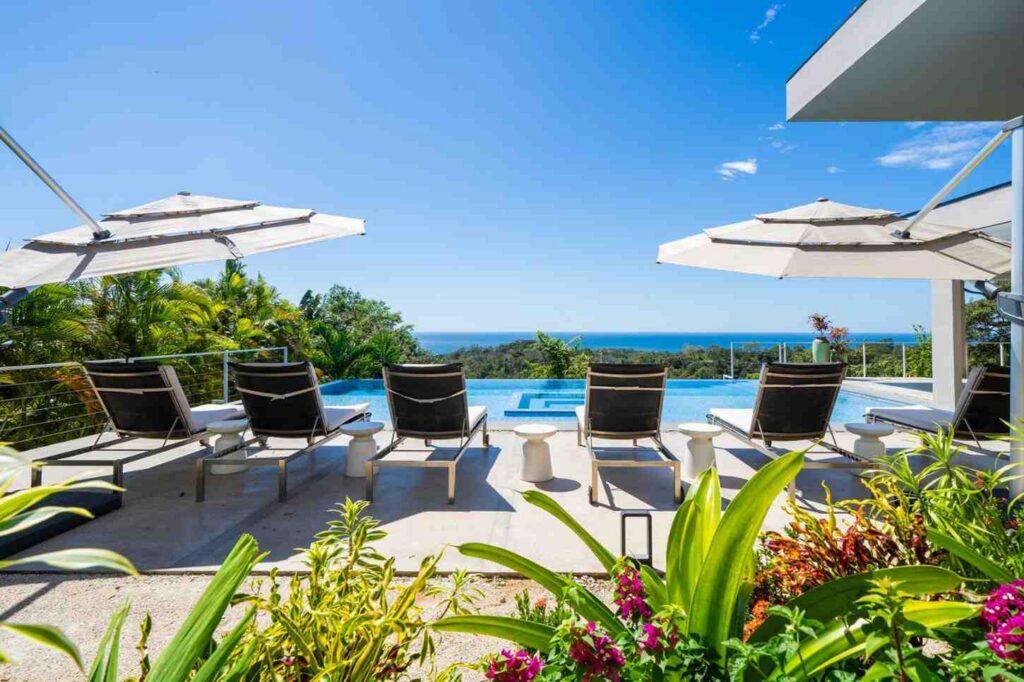
Playa Hermosa: The Quieter, More Private Alternative Just Minutes South
Playa Hermosa sits about five kilometers south of Jaco and delivers a noticeably different experience: a long, dark-sand beach with consistent surf, minimal crowds, and properties that feel removed from the energy of town while remaining close enough to access everything Jaco offers. This is the Gold Coast’s best answer for groups that want privacy first.
The tradeoff is that Playa Hermosa has fewer walkable amenities. You’re driving to Jaco for groceries and restaurants, which means coordinating transportation becomes more essential. For groups that plan to cook most meals at the villa and hire a private chef for the big nights, this is barely a constraint at all.
What Is the Best Region in Costa Rica for Large Group Vacations?
For most large groups arriving from North America, the Gold Coast, specifically the Jaco-to-Playa Hermosa corridor, is the strongest all-around choice. The combination of easy airport access, a mature large-villa rental market, reliable infrastructure, and the density of experienced local property managers creates conditions where things go right more often and get fixed faster when they don’t.
If your group has a specific priority — Arenal’s volcano and hot springs are unmatched for a nature-immersion retreat, Manuel Antonio delivers the most biodiverse national park experience — those regions earn consideration. But the Gold Coast removes more friction than any other region for first-time large group planners, and friction removal is the entire game when you’re coordinating 20 or more people across international travel.
Why Manuel Antonio, Tamarindo, and Arenal Serve Different Group Profiles
Manuel Antonio suits groups where wildlife and national park access are the central purpose of the trip. Tamarindo works well for surf-focused groups, yoga retreats, and guests arriving via Liberia’s Daniel Oduber International Airport from the western U.S. Arenal is the right call for groups that want volcano views, hot springs, and a cloud-forest adventure, typically as part of a multi-stop itinerary rather than a week-long base.
None of these regions are wrong choices. They just serve different group profiles, and the biggest planning mistake is choosing a region based on scenery alone without accounting for how your group gets there, what they’ll do daily, and what happens if someone needs medical attention.
What Amenities Actually Matter When You Have 20 People Under One Roof
Private Pools, Outdoor Kitchens, and the Logistics of Feeding a Crowd
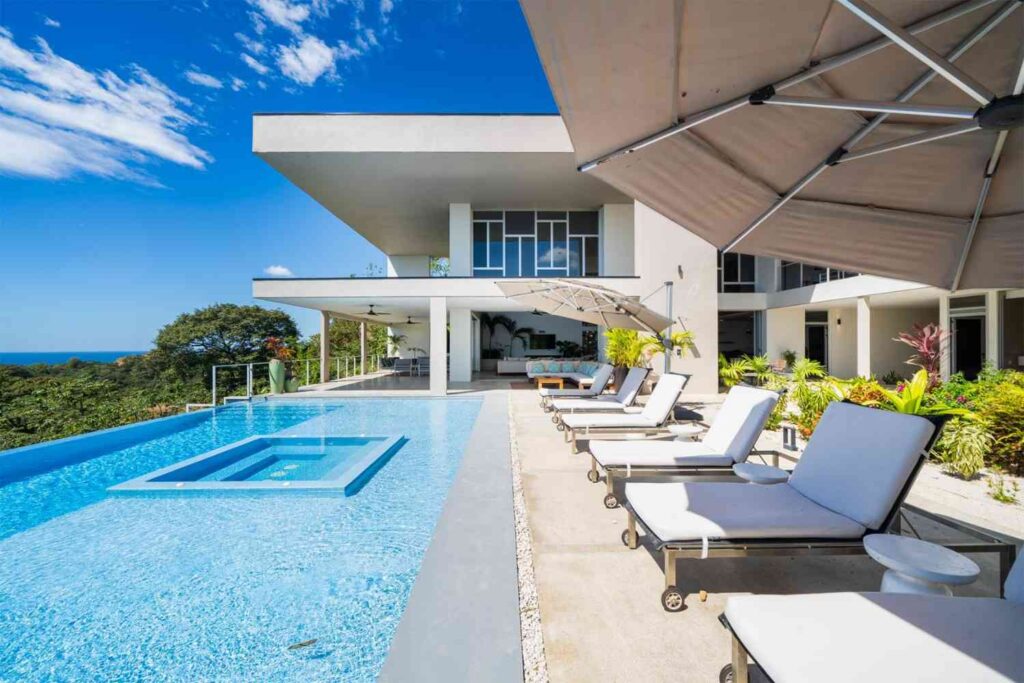
A private pool is not a luxury amenity for a large group — it’s the centerpiece of the day. Plan for a minimum of 40 feet in length for groups over 20. Anything smaller becomes a spectator sport. Covered seating adjacent to the pool, ideally with a wet bar or outdoor kitchen within reach, is what separates a functional pool deck from a truly great one.
The outdoor kitchen question is where many planners underestimate the stakes. Cooking for 20 people requires commercial-grade burner space, large prep surfaces, and refrigeration that can handle bulk groceries. A residential kitchen that looks impressive in listing photos can become a bottleneck the moment a hired chef tries to prepare a group dinner. Ask specifically about burner count, refrigerator size, and whether the property has hosted professional catering before.
Privacy, Perimeter, and Why Beachfront Doesn’t Always Mean Beach Access
Beachfront listings on Costa Rica’s coast require careful reading. Costa Rica’s maritime zone law reserves the first 50 meters from the high-tide line as public land, which means any property described as “beachfront” sits at the edge of a public zone. In practice, this rarely creates problems at Playa Hermosa, where the beach sees minimal outside foot traffic. At more popular beaches, it means strangers can walk directly past your pool area.
Gated perimeter, security staffing, and the property’s actual setback from the beach determine your real-world privacy level. A hillside villa with an ocean view and a private access path often delivers more genuine privacy than a beachfront property with a porous perimeter.
On-Site Support Staff: Chefs, Housekeepers, and Why This Changes Everything
The single biggest upgrade you can make to a large group stay is hiring a private chef for at least three or four evenings during the trip. The math is straightforward: a private chef for a group of 20 costs a fraction of what 20 restaurant meals cost, eliminates the coordination of getting everyone to a restaurant simultaneously, and creates the long-table dinner experiences that become the memories people talk about years later.
Daily housekeeping at a 20-person villa is not optional — it’s infrastructure. Shared spaces accumulate at a rate that surprises first-time group renters, and a clean common area by midday changes the entire atmosphere of the afternoon. Properties that include housekeeping in the rental rate are worth the premium.
Wildlife, Natural Beauty, and the Experiential Amenities That Justify the Trip
The Gold Coast delivers wildlife without requiring a national park expedition. Scarlet macaws in pairs flying over the pool deck at dusk are a routine occurrence around Jaco and Playa Hermosa. Howler monkeys announce sunrise from the trees above hillside properties. Crocodiles line the riverbanks of the Tárcoles, an easy day trip from any Gold Coast base.
This ambient wildlife is one of the region’s most underrated group amenities, because it happens without planning. The collective experience of a group of 20 people falling silent because a troop of monkeys just appeared in the canopy above the pool — that moment doesn’t appear in any activity itinerary, and it doesn’t need to.
The Real Cost of Costa Rica Vacation Rentals for Large Groups
What Is the Average Cost Per Person for a Large Group Villa Rental in Costa Rica?
The per-person cost for a Gold Coast large-group villa rental during peak dry season typically runs $100 to $200 per person per night for a well-appointed property, assuming a group of 20 to 30 guests sharing the total nightly rate. At the luxury end — properties with infinity pools, dedicated staff, and ocean views — that number can reach $250 or more per person per night.
For context, a mid-tier resort room in the same region runs $250 to $400 per night per couple. The math strongly favors the villa for most groups once you factor in kitchen savings, shared common spaces, and the privacy premium.
How to Build a Per-Person Budget That Accounts for the Full Picture
Start with the villa’s nightly rate and multiply by your stay length. Then add these line items before presenting a budget to the group:
- Security deposit (typically $1,500 to $5,000, refundable but held during the stay)
- Cleaning fee (often charged separately, $300 to $800 for large properties)
- Management or booking fee (typically 10 to 15 percent of the nightly rate on properties handled through a management company)
- Chef services, if desired ($100 to $200 per evening for a professional chef, ingredients additional)
- Ground transportation (airport shuttles, day-trip coordination)
- Activity budget per person (surf lessons, tours, zip-line, boat trips)
- Gratuities for household staff
Divide the total by your confirmed headcount, not your hoped-for headcount. Budget shortfalls almost always trace back to optimistic attendance assumptions at the planning stage.
Hidden Fees That Catch Group Planners Off Guard
The fees that create conflict between planners and property managers are almost always the ones that weren’t disclosed clearly upfront. Watch for extra-guest fees triggered when your group exceeds a stated occupancy, generator surcharges in properties that experience power fluctuations, and event fees applied when a property determines your gathering qualifies as a private event rather than a standard vacation stay.
A legitimate property management company discloses all fees in writing before you sign anything. If a rental agreement doesn’t include a clear schedule of potential additional charges, ask for one. If the response is vague, that’s diagnostic information.
Why the Per-Person Cost Often Compares Favorably to a Resort
A mid-tier resort room on the Gold Coast runs $250 to $400 per night per couple in peak season. For a group of 24, that’s $3,000 to $4,800 per night before meals, before activities, and before the private gathering space you’d pay extra to reserve for a group dinner.
A 12-bedroom villa sleeping 24 guests at $4,500 per night works out to $187.50 per person per night, with a private pool, a kitchen that cuts most meal costs, and no strangers sharing your space. Add a private chef for four evenings at $150 per evening and, split 24 ways, that’s $25 per person per dinner. For almost any group that plans to eat together, gather regularly, and use the property as a true base, the villa’s total math wins.
Group Discounts, Negotiation Windows, and When Asking Is Appropriate
Negotiating on a large-group villa rental in Costa Rica is appropriate, but timing and framing matter. The negotiation window opens when you’re booking more than six months in advance for green season or more than twelve months ahead for a dry season peak. At that stage, a confirmed long-stay group booking has real value to a property manager trying to fill a calendar, and a modest discount or added service — an extra cleaning day, one chef dinner included — is a reasonable ask.
Negotiating on price alone during peak availability periods rarely works and can signal that you’ll be a difficult client. A better ask is flexibility on check-in time for a group with a mid-morning flight arrival, or a waived extra-guest fee if you’re close to the property’s stated maximum. These operational accommodations cost the property manager less than a rate reduction and are granted more readily.
Timing, Booking Windows, and Seasonal Intelligence
Dry Season vs. Green Season on the Gold Coast: What Each Means for a Large Group
Dry season runs December through April. You get clear mornings, calm Pacific swells, and reliable beach days. Nightly rates reflect the demand, typically 30 to 50 percent above green season pricing, with the highest premiums around Christmas, New Year’s, and spring break.
Green season, May through November, is not the rain-soaked washout some planners expect. The Gold Coast’s afternoon showers are usually dramatic but brief, clearing by evening to reveal skies that make sunset from a hillside villa genuinely spectacular. The jungle is more vivid, wildlife is more active, and your group has more of the beach to itself. For groups where weather flexibility is manageable and budget is a real factor, May, June, and October offer the best value.
How Far in Advance Should I Book a Large Group Vacation Rental in Costa Rica?
For peak dry season travel, 12 to 18 months is the realistic planning window for the best properties. The inventory of Gold Coast villas that genuinely sleep 20 or more people comfortably is a finite set, and the ones that check every box get reserved by groups who planned ahead.
Green season bookings can sometimes come together in six months, but the best properties still move faster than most planners expect. The risk of waiting is not a higher price — it’s discovering your first-choice property is unavailable and facing a choice between a property that doesn’t quite fit and rescheduling a trip that 25 people have already arranged their calendars around.
The Best Timing by Group Type
- Family reunions with school-age children: Mid-June through early July, and late December through early January. These windows align with school calendars and still offer reliable weather.
- Destination weddings: February and March deliver the most consistent dry weather and the longest days. Avoid the week between Christmas and New Year’s unless your budget is substantial and your lead time is 18 months or more.
- Corporate retreats: January and February offer ideal conditions and easier executive schedule alignment than holiday-adjacent months. May is underrated for corporate groups, with green season rates, excellent weather probability, and none of the family-travel competition for villa inventory.
- Milestone birthdays and anniversary trips: November is the Gold Coast’s hidden gem. The worst of the wet season has passed, green season rates still apply, and the relative quiet of the beach in early November has a particular appeal for groups that want the destination to feel like their own.
Cancellation Policies, Deposit Structures, and Protecting Your Group’s Financial Commitment
Large-group villa rentals carry meaningful cancellation consequences. Most agreements require an initial deposit of 25 to 50 percent at signing, with the balance due 60 to 90 days before arrival. Cancellations within that final window are typically non-refundable.
Two practical protections: travel insurance and a written cancellation matrix shared with every contributing group member before anyone pays. Travel insurance covering trip interruption and cancellation for a group of 20 costs a fraction of what a single lost deposit represents. The cancellation matrix is a clear document showing what each person paid, under what conditions refunds apply, and who is responsible for covering shortfalls if the group size drops. Handling this in writing before the trip — not in a group chat during a stressful moment — is the difference between a friendship-preserving process and a friendship-testing one.
Hosting Events on the Gold Coast: Weddings, Reunions, and Milestone Celebrations
What You Need to Know Before Booking a Property for a Destination Wedding or Reunion
Hosting a celebratory event at a private villa in Costa Rica is genuinely achievable, but the word “event” triggers a different set of logistics than a standard vacation rental. Properties that accept weddings and large gatherings typically require an event addendum to the rental agreement, higher security deposits, and in many cases, a specific list of approved vendors for catering, music, and setup.
The distinction between “a group staying at a villa” and “an event at a villa” matters legally and practically. A property that hasn’t hosted events before may lack the power infrastructure for catering equipment, the parking for outside vendors, or the relationships with local authorities required for a gathering that extends into evening hours.
Permitting, Noise Ordinances, and the Local Logistics That Aggregators Never Mention
Noise ordinances in Costa Rica vary by municipality and are enforced with varying consistency, but they are real. Most residential areas regulate amplified music after 10 or 11 p.m. Properties in Jaco proper are subject to more scrutiny than rural properties in the Playa Hermosa corridor. Weddings and events with live music need to account for this in the timeline. Dinner service at 7 p.m., toasts and dancing by 8 p.m., and music winding down by 10 p.m. is a realistic event arc, not a constraint that ruins an evening.
A local property manager who has navigated these permits knows which events require municipal notification, which require police coordination for vehicle access, and which vendors have the licensing to operate on private property. None of this is information you can assemble from a listing platform.
How Professional Property Management Protects Your Group During a High-Stakes Event
For an event that 60 people have traveled internationally to attend, a property manager who answers the phone at 9 p.m. when the generator trips is not a luxury. It’s the difference between a wedding dinner that happens as planned and one that doesn’t. The generator example is not hypothetical. Power fluctuations do occur, and how fast they get resolved depends entirely on whether someone with the right contacts is reachable.
Professional Costa Rica vacation rental property management also serves a quieter function: accountability before the event. A managed property has been inspected, the pool has been serviced, the backup water tanks are full, and the kitchen equipment has been tested. You’re not discovering on arrival day that the dishwasher doesn’t work.
How to Ensure a Vacation Rental Is Legitimate and Well-Maintained Before Booking Remotely
The Vetting Questions That Reveal Whether a Property Delivers on Its Listing
Before signing any agreement, ask these questions and expect specific answers:
- When was the property last independently inspected, and by whom?
- How many events of this type have you hosted in the past 12 months?
- Who is the on-call contact during our stay, and what is their typical response time?
- Can you provide references from a group of comparable size who stayed in the past year?
- What is the protocol if a significant maintenance issue arises during our stay?
Vague answers to any of these questions are diagnostic. A property that has hosted groups routinely will have direct, specific responses.
Why an On-the-Ground Partner Can Verify What No Photo or Review Can Confirm
Photos can be outdated, staged, or shot from angles that conceal real constraints. Reviews reflect the experience of past guests who may have had different expectations or group sizes. Neither tells you whether the pool pump was replaced last month or the outdoor kitchen’s gas line is reliable under heavy use.
A local partner who has physically walked the property, knows the caretaker by name, and has placed other groups there recently can tell you things no listing ever will: how the master bedroom’s air conditioning actually performs at night, whether the road to the property requires a four-wheel-drive vehicle when it rains, and whether the neighbors are the kind who call the police at the first note of music.
This is the central truth that every large group planner eventually learns, often the hard way: the biggest mistake isn’t choosing the wrong region. It’s trusting a faceless aggregator over a vetted local expert who knows which properties actually deliver on their promises and can provide real support the moment something goes wrong.
Event-Type Quick Match
| Celebration Type | Ideal Property Profile | Best Gold Coast Neighborhood |
|---|---|---|
| Destination wedding (under 50 guests) | 8+ bedrooms, event-ready outdoor space, licensed for gatherings | Playa Hermosa corridor, hillside estates |
| Family reunion (multigenerational) | Single-level access, large pool, full kitchen, caretaker on-site | Jaco or beachfront Hermosa |
| Corporate retreat | Private meeting space, reliable internet, airport proximity | Central Jaco hillside villas |
| Milestone birthday (adults only) | Luxury amenities, chef-ready kitchen, proximity to nightlife | In-town Jaco, walkable properties |
From First-Time Renter to Gold Coast Stakeholder: The Investment Conversation Worth Having
Why Repeat Group Renters Are the Fastest-Growing Segment of Gold Coast Property Buyers
The path from group renter to property buyer on the Gold Coast follows a predictable arc: a first trip that exceeds expectations, a second trip that confirms the attachment, and a third conversation that starts with “what would it actually cost to own something here?” This sequence has become one of the defining patterns in Gold Coast real estate. Groups arrive as vacationers and leave as people who have started to imagine a different kind of relationship with a place.
What the Experience of Renting a Managed Villa Teaches You About Ownership
A well-managed rental stay is an unintentional due diligence exercise. You observe how the property performs under real conditions — how the pool holds up with 20 people using it daily, how the kitchen handles intensive use, how quickly maintenance requests get resolved. You also observe rental demand firsthand. If your property had a waiting list for the dates you wanted, that’s market data. If the caretaker mentions the property books 28 weeks a year, that’s occupancy data most buyers would pay for.
Foreign Ownership in Costa Rica: Dispelling the Three Myths That Stop Most People From Asking
Three beliefs stop most foreign visitors from asking about ownership, and none of them are accurate.
The first is that foreigners can’t own property outright in Costa Rica. They can. Foreign nationals hold the same freehold property rights as Costa Rican citizens for titled land, with no residency requirement.
The second is that the process is too legally complex to navigate from abroad. It requires a Costa Rican attorney and careful title verification, but these are standard steps with well-established processes.
The third is that rental income from a vacation property is difficult to repatriate. Costa Rica has no restrictions on transferring legally earned rental income abroad, and the country’s banking infrastructure handles international transfers routinely.
How Managed Rental Income Transforms a Vacation Property Into a Working Asset
A Gold Coast villa generating a meaningful number of weeks of rental occupancy annually at rates of $1,500 to $4,500 per night can, in many cases, produce gross rental income that covers carrying costs and generates net income beyond them. Green season rentals, corporate retreats, and surf-focused groups that specifically seek the shoulder season create demand across more of the calendar than most first-time buyers expect.
The managed rental model means a local property management company handles bookings, maintenance, guest services, and financial reporting while you use the property for your own group’s annual trip. You own an asset that earns during the months you’re not there.
The Natural Next Step: Exploring Gold Coast Property With a Partner You Already Trust
The most natural ownership conversation is the one that starts with a trusted relationship already in place. A local partner who curated your group’s stay, resolved the problems that arose, and showed you what the Gold Coast actually delivers from the inside is the same partner positioned to show you what ownership looks like on the ground. They know which properties are coming to market, which neighborhoods are appreciating, and which ownership structures are cleanest for foreign buyers. The conversation doesn’t require a separate search for a new expert. It’s a continuation of the one you’ve already started.
Conclusion: Your Group Deserves a Trip That Actually Delivers
The Central Lesson: The Relationship You Book Through Matters More Than the Region You Choose
After all the destination comparisons, sizing frameworks, and seasonal calendars, the factor that most reliably determines whether a large group trip succeeds is the quality of the local relationship behind the booking. The Gold Coast is the right region for most groups arriving from North America. But a great property in a great region, booked through a faceless platform with no local accountability, is still a risk that 25 people are absorbing together. A trusted local partner converts that risk into a managed process with a human being at the other end of a phone call when something needs to be fixed.
The Five Decisions That Determine Whether a Large Group Trip Succeeds or Disappoints
The decisions that matter, in order of impact:
- Who you book through, and whether they have verifiable on-ground accountability
- Whether the property’s bedroom and bathroom count actually fits your group’s composition, not just its headcount
- Whether your budget reflects all costs before you present it to the group
- Whether you’ve booked within the lead time appropriate for your travel window
- Whether an event-specific property, rather than just any large villa, is secured if your gathering qualifies as one
Get these five decisions right and the rest of the trip largely takes care of itself.
How Coastal Realty’s Boutique Approach Serves Both the Trip You’re Planning and the Future You Might Be Imagining
Coastal Realty occupies a specific position in the Gold Coast market that most planning tools can’t replicate: a team with deep local roots, a curated inventory of vetted properties, and the real estate expertise to serve you whether you’re booking a week or exploring what ownership looks like. Every group rental we facilitate starts with a conversation about your group’s specific profile — who’s coming, what matters to them, and what could go wrong and how we prevent it. Every investment conversation starts with the same foundation: direct local knowledge, transparent information, and no pressure to move faster than you’re ready to move.
Your Clearest Next Step
If your dates are within 18 months and your group is beginning to take shape, the clearest next step is a direct conversation — not a listing browse, not a form submission into a queue. Tell us your headcount, your approximate dates, and what your group values most. We’ll tell you which properties fit, what they cost fully loaded, and what your group can expect from the moment your first airport transfer pulls through the gate. Costa Rica vacation rentals for large groups represent one of the most rewarding planning investments you can make, when the planning is done right. We’d like to help you do it right.
Frequently Asked Questions
Is Costa Rica good for group trips?
Yes, genuinely so — and it’s particularly well-suited to groups with mixed ages and interests. The combination of Pacific beaches, accessible adventure activities, excellent food, and a well-developed tourism infrastructure means there’s something for everyone without anyone feeling like they compromised. The Gold Coast’s paved highway access from San José and its concentration of large villas and local service providers make the logistics more manageable than most international group destinations.
Is it better to do a resort or a private villa in Costa Rica?
For most groups of 15 to 40 people, a private villa delivers more value, more privacy, and a better shared experience than a resort. You’re not splitting across hotel corridors or sharing a pool with strangers — everyone is together under one roof, and the per-person cost is often lower once you factor in a shared kitchen and common spaces. Resorts make more sense for groups above 40 guests, for gatherings that require professional event infrastructure, or when guests have widely divergent expectations that a single property can’t serve.
What is the best region in Costa Rica for large group vacations?
For most groups arriving from North America, the Gold Coast — the Jaco-to-Playa Hermosa corridor — is the strongest all-around choice. It offers the shortest transfer from San José’s international airport, the largest inventory of purpose-built large-group villas, reliable roads, developed amenities, and a mature network of experienced local property managers. Other regions like Manuel Antonio, Tamarindo, and Arenal serve specific group profiles well, but the Gold Coast removes more logistical friction than anywhere else in the country.
How far in advance should I book a large group vacation rental in Costa Rica?
For dry season travel (December through April), plan on 12 to 18 months of lead time for the best properties. The inventory of villas that comfortably sleep 20 or more guests is limited, and the ones that check every box — right bedroom and bathroom configuration, ocean views, trusted management, the exact dates you need — go early. Green season bookings can sometimes come together in six months, but even then, the best properties move faster than most planners expect.
What size group requires multiple properties or a resort model?
The practical ceiling for a single private villa is roughly 35 to 40 guests, assuming the property was designed for large groups from the ground up. Above that number, a single home’s infrastructure — septic capacity, water pressure, kitchen throughput, and parking — starts to show strain. At 50 or more guests, the most functional solution is usually two adjacent villas under coordinated management, or a resort that can block off a dedicated section for your group.
How do I ensure a vacation rental is legitimate and well-maintained before booking remotely?
Ask direct, specific questions before signing anything: When was the property last inspected and by whom? How many groups of your size has it hosted in the past year? Who is the on-call contact during your stay, and what is their typical response time? Can they provide references from a comparable recent group? A property with a strong management track record will answer all of these questions clearly and quickly. If the responses are vague or slow, that’s important information. Better still, work with a local partner who has physically walked the property and placed other groups there — they can tell you things no listing or review ever will.
What concierge and support services are available if something goes wrong during our stay?
This depends entirely on how and through whom you book. A well-managed Costa Rica vacation rental property comes with an on-call local contact who can address maintenance issues, coordinate emergency services, arrange last-minute transportation, and connect you with trusted vendors. That on-the-ground accountability is what separates a boutique local management company from a faceless aggregator platform. When something goes wrong — and with large groups, something almost always comes up — the question is whether you have a real person with the right contacts ready to resolve it, or a help ticket in a queue.