
Why Santa Teresa Costa Rica Real Estate Has Become Central America’s Most Sought-After Market
The Pura Vida Factor: Lifestyle, Community, and the Enduring Appeal of the Nicoya Peninsula
Santa Teresa sits on the southern tip of the Nicoya Peninsula, a stretch of coastline that National Geographic has recognized as one of the world’s Blue Zones, where people routinely live past 100. That distinction is not incidental to real estate demand. It signals something about the quality of life here that numbers alone cannot capture: clean air, a slower pace, strong community bonds, and a relationship with the natural world that most buyers haven’t experienced since childhood. Santa teresa costa rica real estate is one of the most searched topics among foreign buyers exploring this part of Central America.
The pura vida ethos is not a marketing phrase. It describes how people actually organize their days on the Nicoya Peninsula, around sunrises, surf sessions, farmers’ markets, and neighbors who know your name. For the foreign buyer who has spent decades optimizing for productivity, that reorientation is the asset.
From Surf Town to Sophisticated Market: How the Gold Coast Became a Global Investment Destination
Fifteen years ago, Santa Teresa was accessible only by a two-hour dirt road from the nearest ferry terminal. That isolation protected it. It also meant that the buyers who arrived early were self-selecting: people who genuinely wanted off the grid, not a resort experience. This is a key dynamic shaping the santa teresa costa rica real estate market in 2026.
What has changed is infrastructure, connectivity, and global awareness. Improved roads, reliable fiber internet, and direct international flights into Liberia and San José have made the Nicoya Peninsula genuinely accessible without erasing what made it special. The result is a market that now draws architects, boutique hotel operators, wellness entrepreneurs, and high-net-worth retirees, a buyer profile that has driven both property values and the quality of the surrounding ecosystem upward together.
Is Santa Teresa Expensive? Understanding the Price-to-Value Equation for Foreign Buyers
Relative to comparable lifestyle destinations like the Algarve, Tulum, Bali, or the French Caribbean, santa teresa costa rica real estate is still meaningfully underpriced. A beachfront villa that would list above $5 million in the Hamptons or Costa del Sol can be acquired here in the $800,000 to $1.5 million range. Entry-level homes with strong rental potential start around $350,000.
The more useful framing is not whether Santa Teresa is cheap (it isn’t, by Central American standards) but whether the asset holds and grows its value. It does. Limited buildable land adjacent to the beach, a regulatory environment that restricts overdevelopment, and sustained international demand create structural price support that more accessible markets lack. Buyers researching santa teresa costa rica real estate will find this pattern consistent across the region.
What Drives Demand: Beachfront Scarcity, Eco-Luxury Appeal, and the Remote-Work Migration Tailwind
Three forces are compressing supply against rising demand simultaneously. First, Costa Rican law places a 50-meter public easement along all coastlines, and the next 150 meters are designated maritime zone land governed by concession rules, which sharply limits the inventory of true fee-simple beachfront titles. Second, the buyers arriving now want something specific: sustainable design, ecological sensitivity, and luxury that doesn’t look like a resort chain. Santa Teresa delivers that aesthetic almost nowhere else does at this price point. Third, the remote-work migration that accelerated after 2020 has not reversed. Digital professionals with location flexibility have discovered that reliable connectivity, a 20-minute walk to the beach, and a cost of living well below San Francisco or New York is not a temporary experiment. It is a permanent upgrade. It is one of the factors that distinguishes santa teresa costa rica real estate from comparable markets.
—
Mapping the Market: Property Types, Neighborhoods, and What Your Budget Actually Buys
The Property Landscape at a Glance
Beachfront and Oceanfront Properties: What “Beach Access” Really Means in Costa Rica
“Beachfront” means different things in different legal contexts here. All beaches in Costa Rica are public. What you own is the land behind the public zone, and the distance, elevation, and sight lines from that land to the water determine both the lifestyle experience and the resale value. A property marketed as “beach access” may require a five-minute walk through a neighbor’s easement. True oceanfront titles, where your lot meets the boundary of the maritime zone directly, command a substantial premium and are genuinely scarce.
Luxury Villas and Eco-Friendly Homes: Where Sustainability Meets Premium Pricing
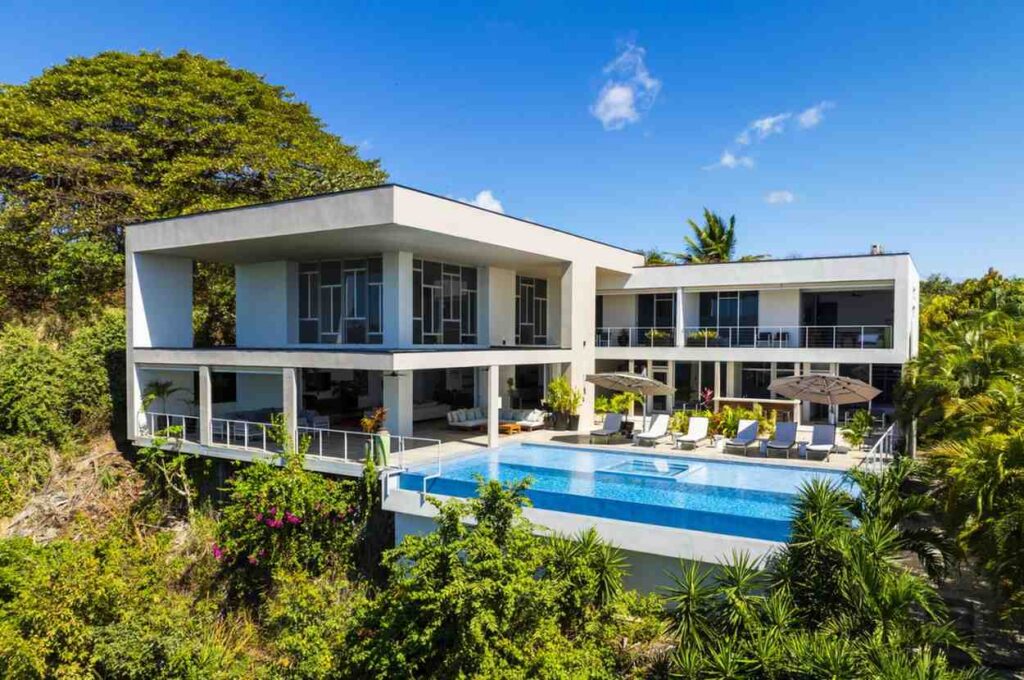
The defining architectural character of high-end beachfront real estate in Santa Teresa is the open-air tropical villa: infinity pool, teak finishes, indoor-outdoor living spaces designed to maximize ocean views and cross-ventilation. Increasingly, buyers are requiring solar panels, rainwater collection systems, and non-invasive landscaping, and developers are responding. Eco-certification is becoming a differentiator rather than an afterthought, and properties that carry it tend to attract both higher nightly rental rates and a more conscientious long-term buyer pool. This context is essential for anyone seriously researching santa teresa costa rica real estate.
Land and Development Lots: Higher Risk, Higher Upside
Raw land acquisitions offer the highest potential return and the widest margin for error. Construction costs in Costa Rica run higher than many buyers anticipate, permits take longer than projected, and contractor quality varies significantly. For buyers with development experience and local professional support, a well-positioned lot in an appreciating corridor can outperform any existing structure. For first-time international buyers, starting with an existing property and a proven rental history is almost always the wiser entry point.
Neighborhood-by-Neighborhood Fit: Matching Your Lifestyle Goals to the Right Micro-Market
Santa Teresa Centro: Energy, Walkability, and Rental Demand
The main strip of Santa Teresa, running along the beach road between Playa Carmen and the northern surf breaks, is the market’s highest-energy zone. Restaurants, yoga studios, surf shops, and a rotating cast of international visitors create a lively streetscape. Rental demand here is consistent year-round and peaks sharply between December and April. The tradeoff is noise, traffic on the unpaved main road, and properties that are closer together than in the southern neighborhoods. The santa teresa costa rica real estate sector has been defined by exactly these dynamics over recent years.
Mal País and the Southern End: Quieter Living and Long-Term Appreciation
Mal País, at the peninsula’s southern tip, offers a fundamentally different experience: more space, more vegetation, fewer neighbors, and a community that skews toward long-term residents rather than seasonal visitors. Properties here tend to sit on larger lots with greater privacy. Rental yields are slightly lower than in the centro, but appreciation trends are strong as buyers priced out of Santa Teresa proper move south. For those active in santa teresa costa rica real estate, this distinction is well understood.
Playa Carmen: The Sweet Spot for Retirees and Absentee Investors
Playa Carmen sits at the intersection of Santa Teresa’s energy and Mal País’s calm. It offers walkable access to the beach and the main commercial corridor without the noise of the centro’s busiest blocks. For retirees who want community amenities nearby without sacrificing tranquility, and for absentee investors who want strong rental occupancy without properties that require constant attention, Playa Carmen consistently outperforms on both dimensions. This is central to understanding what santa teresa costa rica real estate offers right now.
How Much Does Property Cost in Santa Teresa, and Which Neighborhood Is Best for Retirees?
Price per square meter ranges from approximately $1,800 to $2,500 in Mal País, $2,200 to $3,500 in Playa Carmen, and $2,800 to $5,000-plus in Santa Teresa Centro for beachfront or ocean-view properties. Those ranges shift based on title type, lot size, construction quality, and proximity to the water. For retirees specifically, Playa Carmen offers the strongest combination of price accessibility, community feel, and hands-off rental potential, which is why it appears repeatedly in conversations with buyers looking for a property that works financially while they’re away and feels like home when they arrive. Anyone navigating santa teresa costa rica real estate should keep this consideration in mind.
—
Neighborhood Comparison Matrix
| Dimension | Santa Teresa Centro | Playa Carmen | Mal País |
|---|---|---|---|
| Lifestyle Fit | Surfers, remote workers, social travelers | Retirees, couples, part-time residents | Privacy-seekers, long-term residents |
| Rental Yield Potential | High (8–10% gross) | Moderate-High (7–9% gross) | Moderate (5–7% gross) |
| Price per Sq. Meter | $2,800–$5,000+ | $2,200–$3,500 | $1,800–$2,500 |
| Walkability / Amenities | Excellent | Good | Limited |
| Suitability for Absentee Owners | Moderate (higher maintenance demand) | High | Moderate-High |
A few important notes on reading this matrix. Rental yield figures represent gross returns on well-managed properties and will vary based on property type, condition, and management quality. Price per square meter figures reflect a broad market range, and oceanfront parcels at the top of the Santa Teresa Centro column can exceed these figures significantly. The trajectory of santa teresa costa rica real estate reflects these trends directly.
For the absentee owner specifically, Playa Carmen’s “High” rating reflects a practical reality: guests who arrive here rarely need hand-holding. The neighborhood is easy to navigate, the beaches are uncrowded, and the amenities are close enough to satisfy visitors without requiring a car. That translates to fewer service calls, better reviews, and more predictable income, all of which matter more than you’d expect once you’re managing a property from 3,000 miles away.
The “Moderate” rating for Santa Teresa Centro reflects the zone’s higher pace and denser footprint. Strong rentals, yes, but properties there tend to require more active management attention, which increases operational cost for owners who aren’t on-site. This is what separates santa teresa costa rica real estate from comparable opportunities elsewhere.
—
Can Foreigners Buy Santa Teresa Costa Rica Real Estate? Legal Rights Explained
The Short Answer Foreign Buyers Need to Hear First
Costa Rica gives foreign nationals the same property ownership rights as citizens. You do not need to establish residency, form a local company, or obtain government approval before purchasing real estate. A valid passport is sufficient to take title. This equal-treatment principle is codified in Costa Rican law and has been consistently upheld, and it is one of the primary reasons Costa Rica attracts more foreign real estate investment than any other Central American country.
Fee Simple Title vs. Concession Property: The Single Most Important Distinction You Must Understand
This is where the legal landscape requires genuine attention. Costa Rican coastal property falls into two fundamentally different categories, and confusing them is the most common and costly mistake foreign buyers make.
Fee simple (titled) property is registered in the National Registry and functions like property ownership in the United States or Europe. You hold full legal title, can mortgage the property, transfer it, and sell it without restriction.
Concession property sits within the maritime zone (the 50- to 200-meter band from the high-tide line) and is government-owned land that private individuals lease under a municipal concession agreement. You do not own the land. You hold a right to use it, subject to renewal, municipal approval, and specific use restrictions. Concession properties can be excellent investments, but they carry a different risk profile and require additional legal scrutiny, particularly around concession transferability and renewal status.
Never assume that “beachfront” means titled. Always verify the legal status before making an offer.
Is It Safe for Foreigners to Buy Property in Santa Teresa, Costa Rica?
Yes, with the right professional support in place. The legal framework is sound. The National Registry is transparent and publicly searchable. Escrow services used by reputable firms protect your funds. The risks that do exist are not systemic. They are transactional. Undisclosed liens, boundary disputes, unpermitted construction, and misrepresented concession terms are the categories where buyers get hurt, and every one of them is identifiable through competent due diligence before you close.
The buyers who run into serious problems almost always share one characteristic: they skipped a step in the verification process, usually because they were in a hurry or trusted the wrong person. Slow down, verify everything, and use independent legal counsel.
What Legal Requirements Apply to Foreign Buyers Under Costa Rican Law?
The purchase process requires a valid passport, a legal representative licensed in Costa Rica, and a purchase-sale agreement executed before a Costa Rican notary public. The notary also handles title transfer registration with the National Registry. There is no requirement to open a Costa Rican bank account before closing, though having one simplifies ongoing expenses if you plan to rent the property. Some buyers choose to hold title through a Costa Rican corporation (Sociedad Anónima) for liability and estate planning purposes. Your attorney can advise whether that structure makes sense for your specific situation.
The Due Diligence Framework: Title Search, the National Registry, and Escrow Protection
How a Title Search Works and Why It Is Non-Negotiable
The National Registry of Costa Rica (Registro Nacional, also known as the RNPN) maintains a centralized database of all titled property, including ownership history, recorded mortgages, liens, easements, and annotations. A title search through the Registry reveals whether the seller has clean, unencumbered ownership and whether the property’s boundaries match what is being represented. This search is not optional. It is the foundation of your entire transaction. A competent closing attorney conducts this search as standard practice. If yours doesn’t offer it proactively, find a different attorney.
Financing Considerations and What Non-Residents Should Know About Local Lending
Costa Rican banks operate under SUGEF (Superintendencia General de Entidades Financieras) oversight and do lend to foreign nationals, but the requirements are more demanding than in the U.S. or Europe. Expect higher down payments (typically 30 to 50 percent), shorter loan terms, and more extensive income documentation. Most foreign buyers close with cash or use home equity financing from their country of origin. Seller financing exists in some transactions and can be negotiated on a case-by-case basis. If local financing is important to your acquisition strategy, discuss it early with both your attorney and a Costa Rican financial institution.
Do I Need to Hire a Lawyer to Buy Property in Costa Rica?
Yes, and this point is non-negotiable. Costa Rican law requires a licensed notary attorney to execute and register the transfer deed. Beyond the legal requirement, your attorney is your primary protection against the transactional risks described above. Budget $1,500 to $3,000 for attorney fees on a standard residential transaction. It is money you will not regret spending.
Hidden Costs, Closing Fees, and Red Flags to Avoid
Closing costs in Costa Rica typically run 3 to 5 percent of the purchase price, split between buyer and seller by convention (though negotiable). The components include:
- Transfer tax: 1.5% of the registered value
- Legal and notary fees: approximately 1.5 to 2.5% (set by a sliding fee schedule)
- National Registry recording fees: relatively minor
- Municipal and stamp taxes: modest, but present
Beyond closing, budget for annual property taxes (0.25% of registered value, very low by international standards), HOA or community fees if applicable, and ongoing maintenance costs that run higher in a tropical coastal environment than most buyers initially project. Salt air, humidity, and seasonal rain accelerate wear on roofing, paint, and mechanical systems.
Red flags that should prompt you to pause or walk away entirely include: a seller who resists a title search or full National Registry review, any representation that a concession property carries the same security as titled land, pressure to use the seller’s recommended attorney, and verbal assurances about property boundaries that don’t appear in registered survey documents.
Can Buying Property Lead to Residency? Understanding the Investment Residency Pathway
Costa Rica’s Investor Residency category allows foreign nationals who purchase qualified real estate worth $150,000 or more to apply for temporary residency, which can progress to permanent residency after three years. Residency comes with practical benefits including easier banking, access to the public healthcare system (CCSS), and a formal legal status that simplifies property management and financial matters. It does not require you to spend the majority of your time in Costa Rica. For buyers who are considering a longer-term relationship with the country rather than just a property, the investment residency pathway is worth exploring with an immigration attorney in parallel with your real estate transaction.
—
The Investment Case: Vacation Rental Income and Illustrative Return Scenarios
Why Santa Teresa Vacation Rentals Perform: Seasonality, Demand Drivers, and Platform Dynamics
Santa Teresa draws visitors year-round, which gives it a structural advantage over markets that depend on a single season to carry annual occupancy. High season runs December through April, when North American and European travelers arrive in volume seeking dry-weather surfing and warm water. A secondary shoulder season emerges in July and August, driven by school holidays and a wave of European visitors. Even the “green season” (May through November) has become increasingly bookable as travelers discover that Costa Rica’s rainy season means afternoon showers rather than week-long storms, and that rates are lower while beaches are emptier. Smart buyers in the santa teresa costa rica real estate market factor this in from the start.
Short-term rental platforms have amplified this demand curve significantly. Santa Teresa appears consistently in “best surf destinations” and “best remote work locations” editorial content on major travel platforms, driving organic search traffic to property listings without requiring owners to spend on independent marketing. Listings that invest in professional photography, accurate descriptions, and responsive communication routinely earn Superhost status within their first operating year, which compounds visibility and booking rates over time. This dynamic continues to influence pricing and availability across santa teresa costa rica real estate.
Can I Rent Out a Vacation Property in Santa Teresa and Generate Real Income?
Yes, and with meaningful returns when the property is well-positioned and professionally managed. The honest qualifier is that vacation rental income covers a wide range of outcomes depending on property type, location, condition, pricing strategy, and management quality. A beachfront villa in Playa Carmen with a pool, managed by a firm that actively monitors competitive rates and optimizes for occupancy, performs very differently than the same property left in the hands of a part-time caretaker listed at a flat annual rate.
Costa Rica does not restrict foreign owners from renting their properties. Rental income earned in Costa Rica is subject to local withholding taxes (currently 15 percent for short-term rental income remitted abroad), and a tourism VAT of 13 percent applies to rental transactions. These obligations are manageable with proper accounting, but they underscore why your management partner needs to handle financial compliance, not just guest check-ins.
Putting the Numbers in Context: An Illustrative Rental Performance Scenario
The following scenario is illustrative, built from real market conditions in Santa Teresa but not tied to a specific property. Use it as a framework, not a guarantee.
Rate and Occupancy Assumptions for a Three-Bedroom Beachfront Villa
A three-bedroom beachfront villa in Playa Carmen, listed at $650 per night during peak season (December through April), can realistically achieve 75 to 85 percent occupancy across those five months with active management and strong reviews. During shoulder season (July and August), a rate adjustment to $480 to $520 per night maintains 60 to 70 percent occupancy. Green season bookings at $350 to $400 per night typically yield 35 to 45 percent occupancy from budget-conscious travelers and longer-stay remote workers.
Annual Gross Yield, Operating Costs, and Net Return for an Absentee Owner
Running those assumptions across a full calendar year produces roughly $85,000 to $100,000 in annual gross rental revenue for a property purchased at $900,000, representing a gross yield of approximately 9 to 11 percent before costs.
Operating costs for an absentee owner typically include:
- Property management fee: 20 to 25 percent of gross revenue
- Platform fees: approximately 3 percent (Airbnb host fee)
- Utilities, consumables, and guest supplies: $400 to $600 per month
- Preventive maintenance and repairs: $6,000 to $10,000 annually
- Accounting, tax compliance, and legal: $1,500 to $2,500 annually
- Property taxes: 0.25 percent of registered value annually
After these costs, a well-managed property at this price point delivers net returns in the 5 to 7 percent range on purchase price, with the additional upside of underlying asset appreciation that has historically been strong in Santa Teresa’s tightest supply corridors. That combination of income yield plus appreciation is what makes santa teresa costa rica real estate compelling as an investment vehicle rather than simply a lifestyle purchase you hope breaks even.
What Is the Best Time of Year to Buy Property in Santa Teresa?
Green season, counterintuitively, is often the best time to buy. Inventory is at its highest, sellers are more motivated, and properties that were occupied by vacation guests all winter are suddenly available to walk through without scheduling around bookings. You also see the property in its most demanding conditions: if the roof, drainage, and landscaping hold up during the rainy months, they’ll hold up year-round. Prices rarely drop in Santa Teresa during green season, but negotiating leverage shifts toward buyers in a way it doesn’t during the high-season frenzy when multiple offers on desirable listings are common.
For buyers who want to time the market precisely: identify your target property during green season, complete due diligence, and close before November. That positions you to capture the full December high season in your first year of rental income.
—
Beyond the Purchase: How Full-Lifecycle Property Management Protects and Grows Your Investment
The Hidden Risk Every Absentee Owner Faces
The biggest threat to a foreign-owned vacation property in Santa Teresa isn’t market decline or rental underperformance. It’s the slow erosion of asset value that happens when nobody is paying close attention. A roof that needs resealing after a heavy green season. A pool pump repaired by a caretaker’s cousin rather than a licensed technician. An HOA fee that goes unpaid because nobody set up automatic payment. Each problem, in isolation, is manageable. Compounded over three or four years while you’re in another country trusting that no news is good news, they become expensive.
Foreign buyers who close on a property and then try to manage it remotely through a part-time caretaker consistently discover this gap. The solution isn’t just more check-ins. It’s having professional eyes on the asset with a financial stake in its performance.
What Full-Service Property Management Actually Covers for Foreign Owners
Rental Operations, Guest Experience, and Revenue Optimization
A full-service management firm handles the entire guest lifecycle: listing creation, pricing strategy, inquiry response, booking confirmation, check-in coordination, in-stay support, and post-stay review management. Dynamic pricing, where nightly rates are adjusted based on real-time demand data and competitive listings, typically generates meaningfully more revenue than flat-rate pricing over a full year. Guest experience directly affects your review score, which directly affects future occupancy. These connections require daily attention that no absentee owner can provide from abroad.
Maintenance, Vendor Relationships, and Preventing the Slow Erosion of Asset Value
Routine preventive maintenance, not just reactive repairs, is what preserves the condition and resale value of a tropical property. A competent management team conducts regular property walkthroughs, maintains a roster of vetted local vendors, and catches problems at the $200 stage rather than the $2,000 stage. In Santa Teresa’s climate, that means quarterly HVAC checks, annual roof inspections, monthly pool chemistry monitoring, and proactive paint and sealant cycles. Trusted local vendor relationships also mean priority scheduling when something urgent arises between guest stays.
HOA and COA Management: The Administrative Layer That Matters More Than You’d Expect
Gated communities and condominium developments in Santa Teresa operate through HOAs or COAs (Community Owner Associations) that assess monthly or quarterly fees and enforce community standards. Missing fee payments can result in liens against your title. Failing to respond to community votes can affect property use rules. None of this rises to the level of crisis with proper attention, but all of it requires someone who speaks fluent Spanish, has a local address, and knows when the notices arrive. Your property management team handles this layer transparently so it never becomes a problem you discover from abroad.
How Long Does the Home-Buying Process Take, and What Happens After Closing?
From accepted offer to recorded title, a straightforward residential purchase in Costa Rica typically closes in 45 to 90 days. The due diligence period, usually 30 to 45 days, is where your attorney conducts the title search, reviews survey documents, confirms concession status if applicable, and clears any conditions of the sale. Escrow opens when the purchase agreement is signed. Title transfer registers with the National Registry within two to four weeks of closing.
What happens immediately after closing matters as much as the transaction itself. Your rental management team needs 30 to 45 days to photograph the property, build the listing, set up operational accounts, and complete onboarding before the first guest arrives. If you close in October and want to capture December income, that timeline is tight but achievable with advance coordination.
The Lifecycle Partnership Model: Why Your Relationship with Your Advisor Should Outlast the Transaction
A transactional agent’s job ends at closing. A lifecycle partner’s job begins there. The distinction is real and consequential. The advisor who helps you find and purchase a property should also be the team that manages it, monitors the market on your behalf, alerts you to adjacent opportunities as your equity grows, and helps you execute an exit strategy when the time comes.
This model benefits the owner because consistency of knowledge about your specific asset compounds over time. The team that managed your villa through three green seasons knows which vendor fixes the generator, which neighbors share the access easement, and which rental platform performs better for your property type. That institutional knowledge is not transferable to a new firm at year three without significant friction and learning cost.
—
Boutique Expertise vs. Franchise Reach: Why Your Choice of Advisor Is More Consequential Than Your Choice of Property
What a Franchise or Listing Portal Can and Cannot Do for a Foreign Buyer
Large franchise networks and listing portals offer something valuable: broad inventory and national brand recognition. What they cannot offer is institutional knowledge of a specific micro-market like Santa Teresa’s Gold Coast, where the difference between a concession lot with transferability issues and a clean fee-simple title two streets inland requires someone who has been watching that specific corridor for years. Franchise agents rotate. Portals show listings without context. Neither is built to stay with you through management, maintenance, and eventual resale.
For a buyer purchasing property in a country they don’t live in, transactional support is the minimum viable service. What you actually need is an advisor who can answer a question about a specific property’s HOA history, recommend a contractor they’ve used personally, and pick up the phone when a pipe bursts the night before a peak-season arrival.
The Boutique Advantage: Deep Gold Coast Market Knowledge Built Over Nearly Two Decades
Local expertise in real estate is not generalist knowledge that can be acquired quickly. The Gold Coast market covering Santa Teresa, Playa Carmen, and Mal País has distinct pricing dynamics, legal nuances in how coastal titles are structured, and community relationships that determine which properties actually come to market versus which ones trade quietly between people who already know each other. An advisor who has spent nearly two decades here has seen properties cycle through two or three owners, watched which neighborhoods appreciated fastest after infrastructure improvements, and knows which developers consistently deliver on their promises.
That depth of context is simply unavailable to a buyer who arrives with listings printed from a portal.
First-Name-Basis Service and What It Means When Something Goes Wrong at 11pm
There is a specific kind of anxiety that comes with owning a property you cannot see or reach quickly. A guest who can’t access the lockbox at 9pm. A water heater that fails two days before a holiday arrival. A neighbor who claims a boundary line has moved. Each of these situations has a straightforward resolution when the right person is already in relationship with your property and your vendors. When your advisor is a name you remember rather than a ticket number in a queue, those resolutions happen in hours, not days.
How to Evaluate Any Real Estate Firm Before You Commit
Before engaging any firm, ask directly: How many transactions have you closed for foreign buyers in Santa Teresa specifically? Who handles the property after closing, and is that team in-house or outsourced? Can you provide references from absentee owners who have held their properties for more than three years? How do you handle legal issues that arise post-closing? What does your management reporting look like, and how frequently do owners receive it?
A firm that answers these questions with specifics and offers references without hesitation is a firm worth continuing the conversation with.
—
Five Non-Negotiables for Vetting a Santa Teresa Costa Rica Real Estate Advisor
Before signing anything, confirm that your prospective advisor meets each of these criteria:
- Demonstrated track record of closed transactions with foreign buyers specifically in the Santa Teresa Costa Rica real estate market, not just Guanacaste or Costa Rica broadly
- In-house property management capability, not a referral to a third party, so your pre-purchase advisor and post-purchase manager share institutional knowledge of your asset
- Established relationships with licensed Costa Rican attorneys and the ability to recommend independent legal counsel who does not represent the seller
- Verifiable client references from foreign owners currently renting their properties, not just buyers who closed and moved on
- Clear, written explanation of fee structures for both the transaction and any ongoing management services, with no undisclosed referral arrangements
—
Your Step-by-Step Buyer Journey: From First Conversation to Keys in Hand
Step One: Clarifying Your Goals Before You Look at a Single Listing
The most common mistake buyers make is starting with properties instead of priorities. Before any listing is worth evaluating, you need answers to a small set of foundational questions. Is this primarily a lifestyle purchase, an investment vehicle, or both? How many weeks per year will you use the property personally? Are you comfortable with a property that requires active management, or do you need something hands-off? What is your realistic all-in budget, including closing costs, initial improvements, and a reserve fund for the first year of operations?
Your advisor’s first job is to help you get clear on these questions, because the answers determine everything that follows: which neighborhoods are relevant, which property types make sense, and what success looks like for your specific situation.
Step Two: Remote Market Orientation and the Curated Property Discovery Process

Most buyers do preliminary research from home before their first visit, and that is entirely appropriate. A good advisor supports this phase with a curated overview of current market conditions, relevant listings, and neighborhood context specific to your stated goals. This is not a portal-style flood of every available listing. It is a filtered, annotated shortlist with honest assessments of each property’s strengths and tradeoffs.
When you visit in person, your time should be spent on the properties that genuinely match your criteria. A well-prepared visit of three to five days is typically sufficient to make a confident decision when the pre-visit groundwork has been done correctly.
Step Three: The Offer, the Legal Review, and the Due Diligence Window
When you identify the right property, your advisor helps you structure an offer that reflects current market conditions and protects your interests. The purchase agreement includes a due diligence window, typically 30 to 45 days, during which your attorney conducts the title search, reviews survey documents, and confirms all representations made by the seller. Your deposit is held in escrow and is refundable if due diligence surfaces a material issue you choose not to proceed through.
This window is not a formality. Use it fully. Ask questions about anything that isn’t clear. A rushed due diligence period is where problems get missed.
Step Four: Escrow, Closing, and Taking Title as a Foreign National
Once due diligence is satisfied, escrow moves toward closing. Your notary attorney prepares the transfer deed, both parties sign, and the attorney registers the transfer with the National Registry. As a foreign national, you take title in your own name or through a Costa Rican corporation if your attorney recommends that structure. The National Registry records the transfer within two to four weeks, and you receive certified copies of the registered deed.
Closing costs, as covered earlier, run 3 to 5 percent of the purchase price. Have funds ready in advance so the closing timeline isn’t delayed by wire transfer logistics.
Step Five: Activating Your Property Through Rental Onboarding and Management Setup
Closing day is when the investment phase begins, not ends. In the weeks immediately following, your management team photographs the property, creates or optimizes rental listings, establishes local operating accounts, and builds the vendor relationships specific to your property.
Your first year as a rental owner is a calibration year. Pricing adjusts as you accumulate reviews. Guest feedback reveals property features worth improving. Occupancy patterns clarify which seasons perform strongest for your specific location and property type. A management team that shares this data transparently, through monthly owner statements, occupancy reports, and maintenance logs, turns that first year into actionable intelligence for the second and third years.
By year two, a well-managed Santa Teresa Costa Rica real estate property with strong reviews and an established guest history is effectively running itself, generating income while you live your life elsewhere. That is the outcome this process is designed to deliver.
—
Conclusion: Your Santa Teresa Costa Rica Real Estate Dream Is Closer Than You Think
The Core Truth: The Right Advisor Unlocks the Investment; the Wrong One Puts It at Risk
Everything covered in this guide points toward one conclusion that deserves to be stated plainly: the quality of your advisory relationship determines your outcome more than the property you choose. A well-priced beachfront villa with a compromised title is a liability. A modest Playa Carmen home with clean title, professional management, and a vetted legal team is a performing asset. The property is the vehicle. The advisor is what makes the engine run.
Foreign buyers who succeed in santa teresa costa rica real estate consistently share one trait: they invested in relationships before they invested in property. They asked hard questions of their advisors, retained independent legal counsel, demanded references, and treated due diligence as the non-negotiable center of the transaction. The ones who ran into trouble skipped one of those steps, usually under time pressure or social pressure from a seller eager to close.
The Coastal Realty Difference: Nearly Two Decades of Gold Coast Partnership
Coastal Realty has been operating on the Gold Coast since before Santa Teresa appeared on international radar. That tenure is not a marketing claim. It is the reason our team knows which specific streets flood in heavy rain, which developers deliver on their architectural promises, and which properties have traded quietly between networks before they ever reached a public listing. That institutional knowledge is not available on a portal.
More practically, our work does not end at closing. The same team that helps you find and structure a purchase manages your property, monitors your rental performance, coordinates your vendors, and remains your point of contact when something needs attention from thousands of miles away. That continuity of relationship is what transforms a foreign real estate transaction into a genuinely manageable, income-producing asset.
Your Next Step: Starting the Conversation
The buyers who are happiest two years after closing are the ones who started with a conversation, not a listing search. They shared their goals, their constraints, and their questions with an advisor who could help them think clearly before commitment.
If you have read this far, you have the foundation. You understand the legal framework, the neighborhood dynamics, the rental income mechanics, and the management infrastructure that makes absentee ownership work. What happens next depends on whether you take the step from informed to action.
Reach out to our team at Coastal Realty. Tell us what you are hoping to build. The conversation is free, there is no pressure, and it may turn out to be the most useful hour you spend this year.
—
Frequently Asked Questions
Is it safe for foreigners to buy property in Santa Teresa, Costa Rica?
Yes, with the right professional support in place. Costa Rica’s legal framework for property ownership is transparent and well-established, and the National Registry is publicly searchable. The risks that exist are transactional rather than systemic, and they are virtually all identifiable through competent due diligence before closing. Working with an independent attorney and a reputable advisory firm eliminates the vast majority of exposure.
What are the legal requirements for foreign property ownership in Costa Rica?
Foreign nationals can purchase and hold property in Costa Rica under exactly the same legal framework as citizens. You need a valid passport, a licensed Costa Rican attorney to represent you, and a purchase-sale agreement executed before a notary public. No residency, government approval, or special permit is required. Your attorney handles title registration with the National Registry on your behalf.
How much does property cost in Santa Teresa, and what is the best neighborhood for retirees?
Entry-level homes with rental potential start around $350,000, while beachfront villas typically range from $800,000 to $1.5 million depending on location, title type, and construction quality. For retirees specifically, Playa Carmen offers the strongest combination of price accessibility, community feel, and hands-off rental potential. It provides walkable access to the beach and amenities without the noise and density of Santa Teresa Centro, making it well-suited for both personal enjoyment and absentee ownership.
What hidden costs should I expect when buying real estate in Santa Teresa?
Closing costs total 3 to 5 percent of the purchase price and cover transfer tax, legal and notary fees, National Registry recording fees, and municipal stamp taxes. Beyond closing, plan for annual property taxes (0.25 percent of registered value), HOA or community fees if applicable, tropical maintenance costs that run higher than most buyers initially project, property management fees of 20 to 25 percent of gross rental revenue if you plan to rent, and annual accounting and tax compliance costs. None of these are surprising once you know to expect them.
Do I need to hire a lawyer to buy property in Costa Rica?
Yes, and this requirement is both legal and practical. Costa Rican law requires a licensed notary attorney to execute and register the transfer deed. Beyond that legal requirement, your attorney is your primary protection against undisclosed liens, boundary disputes, and misrepresented concession status. Budget $1,500 to $3,000 for attorney fees on a standard residential transaction, and always retain counsel who is independent from the seller.
What is the best time of year to buy property in Santa Teresa?
Green season (May through November) is often the best time to buy. Inventory is higher, sellers are more motivated, and you can view properties under their most demanding weather conditions, which tells you far more about a roof or drainage system than a dry-season visit ever will. Negotiating leverage also shifts toward buyers during this period. For investors, closing before November positions you to capture the full December high season in your first year of rental income.