
Beyond the Vacation Brochure: Why Las Catalinas Deserves a Second, Closer Look
What Las Catalinas Is — and Why It’s Unlike Any Other Costa Rica Community
Las Catalinas is a planned coastal community on the Pacific coast of Guanacaste, Costa Rica, and calling it a “resort town” undersells what it actually is. Built from the ground up on a hillside above Playa Danta, it was designed as a permanent, functioning village where people live, not just visit. That distinction matters enormously if you’re considering buying here.
Most coastal developments in Costa Rica follow a familiar playbook: buy land, build condos, fence off a pool, and sell vacation units. Las Catalinas took the opposite approach. Its founders looked at what makes communities in the Mediterranean feel timeless and livable, then applied those principles to a 1,100-acre site in one of the most desirable corners of Central America. The result is something genuinely rare: a place that functions as a real neighborhood rather than a collection of investment units waiting to be rented out.
The Vision Behind the Car-Free, Walkable Design
No cars inside the community. That single design rule changes everything about how Las Catalinas feels to live in, and how it holds its value over time.
Streets are cobblestone. Residents and guests move on foot, bicycle, or golf cart. Children play in plazas without traffic concerns. Neighbors actually know each other because they walk the same paths every day. This isn’t an aesthetic choice. It’s a structural commitment to a quality of life that most communities claim but almost none deliver.
For buyers, the car-free design creates something you can’t replicate in a standard development: a self-reinforcing community character. Because the layout prevents the drive-through anonymity you get in most beach towns, Las Catalinas retains a village atmosphere regardless of how full or empty it is on any given week. That consistency is precisely what sustains rental demand and long-term property values.
Playa Danta, Cobblestone Streets, and Italianesque Architecture
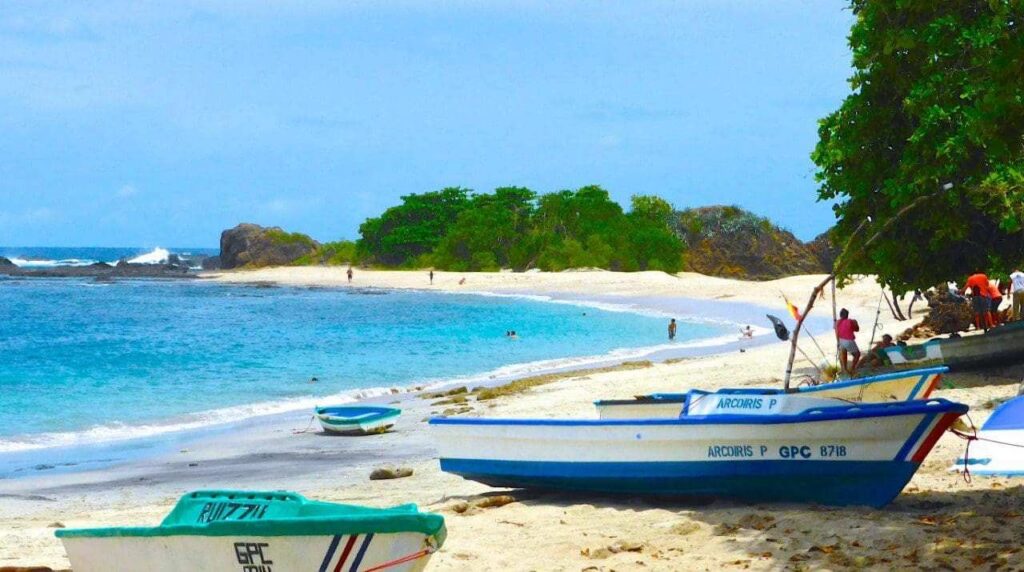
Playa Danta is the community’s primary beach, a calm, semi-protected cove that’s swimmable most of the year and visually striking in every season. The beach sits just minutes from the town center on foot, which means owning here puts you in daily walking distance of the Pacific regardless of where your property sits within the community.
The architecture throughout Las Catalinas draws from Mediterranean and Italianesque influences: warm stucco facades, terra cotta rooflines, arched passageways, and shaded colonnades that keep the heat bearable even in dry season. This isn’t decorative theming. The building codes maintain these standards across all structures, which means the aesthetic coherence is permanent and protected. What you see when you buy is what the community will look like in twenty years.
Beyond Playa Danta, the community maintains an extensive trail network connecting to additional beaches and hillside viewpoints. Hiking, mountain biking, paddleboarding, and snorkeling are all accessible without getting in a car. For buyers evaluating lifestyle, this is the daily texture of ownership.
Where Las Catalinas Sits on the Costa Rica Gold Coast
Las Catalinas sits on what locals and real estate professionals call the Gold Coast, the stretch of Pacific coastline in Guanacaste that runs roughly from the Papagayo Peninsula south through Flamingo, Potrero, and Tamarindo. This corridor has seen consistent infrastructure investment and tourism growth for two decades, and Las Catalinas sits squarely within it.
Getting Here: Airports and Travel Time
The primary gateway is Daniel Oduber Quirós International Airport in Liberia (LIR), which receives direct flights from major U.S. cities including Miami, Houston, Dallas, New York, and Atlanta. Drive time from Liberia to Las Catalinas is approximately 75 to 90 minutes on paved roads. For buyers who plan to visit frequently or eventually live here part-time, that direct connectivity is a meaningful quality-of-life factor: no layovers in San José, no multi-hour drives across the country.
Juan Santamaría International Airport in San José (SJO) is also an option if your routing makes it more practical, though the drive adds roughly three to four hours to your journey.
Proximity to Flamingo Beach, Potrero, and the Broader Guanacaste Region
Las Catalinas sits directly adjacent to Playa Potrero and within a short drive of Playa Flamingo Beach, one of the Gold Coast’s most established communities, with a full-service marina, supermarkets, medical facilities, and restaurants. Tamarindo, the region’s most developed tourist hub, is about 45 minutes away.
This location gives Las Catalinas owners the best of both contexts: the insulated, intentional character of a planned community and easy access to the broader regional infrastructure that makes long-term living practical. You’re not isolated. You’re simply protected from the noise.
—
Life Inside Las Catalinas: What Daily Ownership Actually Feels Like
A Day in the Community
Ownership here has a specific rhythm. Mornings typically start early, the light is extraordinary, and the trails are coolest before 9 a.m. Many owners walk to Playa Danta before breakfast, swim, then return through the town center for coffee at one of the small restaurants near the plaza. The afternoon heat invites a slower pace: reading in the shade, paddleboarding in the cove, or simply watching the Pacific from a terrace. Evenings gather people naturally at the restaurants and gathering spaces that anchor the town center.
This isn’t marketing copy. It’s the daily pattern that residents and repeat visitors consistently describe, and the design of the community makes that rhythm almost automatic.
What Las Catalinas Is Known For
Las Catalinas is known for three things that, together, are hard to find anywhere else on the coast: walkability, community coherence, and natural access. The car-free layout, the maintained trail network connecting multiple beaches, and the architectural consistency combine to create an atmosphere that feels Mediterranean by design and Costa Rican by character.
What it’s not known for is nightlife, large-scale resort amenities, or the kind of high-volume tourism that defines places like Tamarindo or Jacó. That’s deliberate. If you’re looking for a packed pool bar and daily organized excursions, Las Catalinas isn’t your match. If you’re looking for a genuinely livable coastal community where you recognize your neighbors and can walk to the ocean in five minutes, it’s very hard to beat.
Seasonal Realities: Dry Season, Green Season, and Year-Round Livability
Guanacaste has two distinct seasons. The dry season runs from roughly November through April, bringing consistent sunshine, low humidity, and the peak tourism and rental period. The green season, May through October, brings afternoon rains, lush hillside vegetation, and noticeably fewer visitors.
For owners, both seasons have genuine appeal. Dry season is when you’ll see the strongest rental returns and when the community buzzes with activity. Green season is quieter, cooler in the afternoons, and, if you’re using the property yourself, arguably the more beautiful time to be here. The landscape transforms, rates for services and travel drop, and you have the beaches largely to yourself.
Can You Drink the Water in Las Catalinas?
Yes. Las Catalinas operates its own water treatment infrastructure, and tap water in the community meets potable standards. This is not the case in every coastal community in Costa Rica, and it reflects the level of infrastructure investment built into the development from the start.
Retirement Living, Remote Work, and the Case for Long-Term Residency
Las Catalinas has become a genuine draw for two specific groups beyond the vacation renter: retirees looking for a walkable, low-stress environment with strong community ties, and remote professionals who want a high quality of life outside the U.S. or Canada without sacrificing connectivity.
Both groups find what they’re looking for here. The community has reliable high-speed internet. Proximity to Flamingo provides access to healthcare, banking, and daily necessities. The lifestyle, outdoor, social, and relatively unhurried, maps well onto what both groups are seeking. And Costa Rica’s legal framework, which we’ll cover in the next section, makes long-term residency genuinely accessible for buyers at the right investment threshold.
Community Vibe: Owners, Renters, and Neighbors
The community is a mix of full-time residents, part-time owners who visit seasonally, and short-term renters. Full-time residents are a minority but a meaningful anchor, typically retirees or remote workers who’ve made Las Catalinas their primary home. Part-time owners, many of them American or Canadian, tend to use the property for one to three months a year and rent the rest of the time. Short-term renters cycle through year-round, with peak volume in dry season.
The mix creates a community that stays alive even outside peak season without ever feeling like a theme park. The people who live here, even part-time, tend to be invested in the community in a way that transient resort guests simply aren’t.
—
The Foreign Buyer’s Legal Roadmap: Owning Property in Costa Rica With Confidence
What Costa Rica’s Constitution Actually Says About Foreign Property Ownership
Costa Rica’s constitution grants foreign nationals the same property rights as citizens. This isn’t a workaround or a legal technicality. It’s a foundational principle of Costa Rican law that has been in place for decades. As a foreign buyer, you can own titled property outright, in your personal name, with the same legal protections afforded to any Costa Rican resident.
This stands in contrast to countries like Mexico, where foreign buyers in coastal zones must use a fideicomiso (bank trust) structure, or Thailand, where foreign freehold ownership of land is broadly restricted. Costa Rica has no such barrier. You buy, you own.

How Titled Property Rights Work for Non-Citizens
Titled property in Costa Rica is registered in the Registro Nacional (National Registry), the country’s public property registry. When you purchase a titled property, a deed (escritura) is executed by a Costa Rican notary-attorney, registered in the Public Registry, and the title transfers to your name. The title is public record, searchable, and legally protected.
Properties in Las Catalinas are titled, not concession land, not maritime zone property, which means you hold clean fee-simple ownership. This is the most secure form of real property ownership available in Costa Rica, and it’s the standard for all residential properties within the community.
The Step-by-Step Purchase Process for Non-Resident Buyers
The purchase process for a foreign buyer in Costa Rica follows a predictable sequence once you understand the roles involved. Here’s how it works in practice.
Step 1: Identify your property and agree on price. Work with a licensed local real estate agent who knows the Las Catalinas inventory. Negotiate purchase price and basic terms before engaging attorneys.
Step 2: Hire a Costa Rican attorney. Your attorney represents your interests and is distinct from the notary who executes the deed. This is not optional. It’s your primary protection against title issues, liens, and undisclosed encumbrances.
Step 3: Conduct due diligence. Your attorney pulls a title search through the Registro Nacional to confirm clean ownership, check for liens or mortgages, verify property boundaries, and review any HOA or COA obligations tied to the property.
Step 4: Sign a purchase-sale agreement (Opción de Compra). This is a binding contract that sets price, deposit amount (typically 10%), and closing timeline. Your deposit is held in escrow. Use a licensed escrow company, not a direct transfer to the seller.
Step 5: Complete financing arrangements. If you’re financing through a Costa Rican bank or private lender, finalize those terms before closing. If you’re paying cash, confirm wire transfer logistics with your attorney and escrow company.
Step 6: Attend closing or authorize a power of attorney. A Costa Rican notary-attorney executes the transfer deed. You can be present in person or grant power of attorney to your attorney to sign on your behalf, a common arrangement for non-resident buyers.
Step 7: Pay closing costs and transfer taxes. These are due at closing. The next section covers what to budget.
Step 8: Register the deed. Your attorney submits the executed deed to the Registro Nacional. Registration typically takes two to six weeks. Once registered, you are the legal titleholder on public record.
Step 9: Transfer utilities and HOA obligations. Update service accounts and notify the Las Catalinas COA of the ownership change to ensure a clean transition.
The Role of a Costa Rican Attorney, a Notary, and the Public Registry
In Costa Rica, the notary and the attorney are often the same person, a licensed abogado-notario who is authorized both to provide legal counsel and to execute official deeds. The seller’s attorney typically serves as the closing notary, which is standard practice. Your job as a buyer is to have your own independent attorney reviewing everything before you sign.
The Registro Nacional is the backbone of Costa Rican property security. Every titled transaction is recorded there, and anyone can search it. Before any money changes hands, your attorney should pull a current registry report (certificación) confirming the seller’s ownership, the property’s legal description, and any encumbrances. This step is non-negotiable.
Common Pitfalls for Foreign Buyers — and the Red Flags to Watch
The risks in Costa Rican real estate are real, but they’re also predictable and avoidable with the right representation. Watch for these warning signs:
- Skipping independent legal counsel and relying on the seller’s attorney to protect your interests
- Wiring deposits directly to a seller or agent rather than using a licensed escrow company
- Purchasing concession property or maritime zone land without fully understanding the restrictions on foreign ownership of those specific property types
- Failing to confirm that HOA or COA dues are current, because unpaid dues can follow a property, not just the seller
- Buying based on verbal representations about rental income or property boundaries without verifying both in writing and through the registry
A qualified local attorney catches all of these before they become your problem.
Costa Rica Residency Through Real Estate Investment
Costa Rica offers residency categories including Rentista and Inversionista (investor) residency for those who make qualifying investments in the country. The investor residency has historically required a minimum investment threshold in registered assets, though program specifics do change, and you should confirm current requirements with a qualified immigration attorney.
Property ownership alone does not automatically confer residency. But for buyers who want to spend more than 90 days per year in Costa Rica, the standard tourist visa limit, formal residency is the path forward. A real estate investment at or above the qualifying threshold can support that application. Many Las Catalinas buyers pursue this route once they decide to make the community their primary or seasonal home.
—
Understanding the True Cost of Ownership: No Surprises, No Fine Print
How Much Does Property Cost in Las Catalinas?
Las Catalinas real estate investment options range widely depending on type, size, and position within the community. Entry-level options, smaller casitas or studio-style units, start in the $400,000 to $600,000 USD range. Mid-range homes and townhouses with beach or ocean orientation typically fall between $700,000 and $1.5 million. Premium ocean-view villas and larger custom homes push well above $2 million.
Pricing reflects the community’s intentional scarcity. Las Catalinas controls its own development density, which limits supply and supports values over time. Oversupply is not a near-term risk in this market.
Closing Costs, Transfer Taxes, and Legal Fees
Budget 3.5% to 5% of the purchase price for total closing costs as a foreign buyer. The components break down roughly as follows:
- Transfer tax: 1.5% of the registered property value
- Documentary stamps and registry fees: approximately 0.5% to 1%
- Notary fees: set by law at a sliding scale, typically 1% to 1.5% of the transaction value
- Your independent attorney’s fees: typically $1,500 to $3,500 USD depending on complexity
- Escrow fees: typically $500 to $1,000 USD
Costa Rica transfer taxes are assessed on the registered value of the property, which is sometimes lower than the actual purchase price. Your attorney can walk you through how this applies to a specific transaction.
Annual Property Tax in Plain English
Costa Rica’s annual property tax, the Impuesto Sobre Bienes Inmuebles, is assessed at 0.25% of the registered property value per year. On a property registered at $500,000 USD, that’s $1,250 annually. Even on a $1 million property, you’re looking at $2,500 per year. Compared to property tax rates in most U.S. states, this is negligible.
Property values for tax purposes are self-declared and updated periodically, with municipalities conducting reassessments over time. In most cases, registered values trail market values in Las Catalinas, which means your effective tax rate relative to actual market value is even lower than the headline rate suggests.
HOA and COA Fees: What They Cover and Why the Structure Matters
Las Catalinas operates through a Community Owners Association (COA) rather than a traditional HOA. The distinction matters. The COA structure gives property owners governance rights and a voice in how shared spaces and services are managed, rather than deferring to a developer-controlled board.
COA fees cover the maintenance of shared infrastructure, including cobblestone streets, landscaping, the trail network, beach access facilities, security, and community amenities. Fees vary by property type and size but generally run in the range of $500 to $1,500 USD per month for residential properties, with some variation depending on the specific sub-association your property falls under.
For buyers, this structure is a feature, not a burden. The fees fund what makes Las Catalinas distinctive, the immaculate common areas, the maintained trails, the security that makes the community feel well-managed year-round. And because the COA is owner-governed, the people paying the fees are the same people deciding how they’re spent.
Utilities, Insurance, and Ongoing Maintenance
Beyond taxes and COA fees, a realistic ownership budget should include the following:
- Utilities: electricity, water, and internet typically run $200 to $500 USD per month depending on property size and usage. Air conditioning is the primary driver of electricity costs in Guanacaste.
- Property insurance: budget $1,500 to $3,000 USD annually for a standard residential policy covering structure and contents.
- Maintenance and repairs: set aside 1% to 1.5% of property value annually for routine upkeep. Tropical climates accelerate wear on exterior surfaces, HVAC systems, and landscaping.
- Property management fees: if you’re renting the property and using a management company, which most non-resident owners do, expect fees in the range of 20% to 30% of gross rental revenue.
A realistic all-in annual ownership cost for a mid-range Las Catalinas property runs $25,000 to $45,000 USD per year before any mortgage service. Owners who rent consistently during dry season often offset a meaningful portion of that figure.
Financing as a Foreign Buyer
Financing is available for foreign buyers in Costa Rica, but the terms differ from what you’re accustomed to in the U.S. or Canada. Costa Rican banks will lend to non-residents, but typically at higher interest rates, often 7% to 10% in USD-denominated loans, with lower loan-to-value ratios of 50% to 70%, and with more documentation requirements than domestic lenders impose.
Private lending is also an option. Some sellers in Las Catalinas will carry financing directly, and private Costa Rican lenders operate in the market. Rates are higher, but terms can be more flexible.
The most common approach for foreign buyers in the Las Catalinas price range is a cash purchase or financing through a home equity line or cash-out refinance on a U.S. property. This sidesteps Costa Rican lending complexity entirely and often results in faster, cleaner closings. If you need local financing, it’s achievable. Just plan for a longer process and work with a lender experienced with non-resident borrowers.
—
Vacation Rental Income vs. Long-Term Residency: Mapping the Right Path for You
The Vacation Rental Opportunity: Revenue Model and Demand Drivers
Most buyers arrive at Las Catalinas with one of two visions: a property that pays for itself through short-term rentals, or a personal retreat they can eventually call home full-time. Both are viable here. The community’s structure supports both models, but the financial profile and lifestyle trade-offs differ substantially.
The vacation rental case rests on genuine demand drivers. Las Catalinas has a well-established reputation as a premium coastal destination that attracts travelers who have moved past the all-inclusive resort phase of their travel life. These guests research intentionally, book higher-end accommodations, and return. The car-free village design, Playa Danta Beach access, and architectural character are what they’re paying for, and those features don’t erode over time.
Dry season, November through April, is the peak rental window. A well-managed, well-positioned property can achieve consistent occupancy during these months at nightly rates that reflect the community’s premium positioning. Green season occupancy drops, but so do operating costs, which affects your net position. Owners who price dynamically and maintain quality between stays typically outperform those who set flat rates and hope for the best.
Rental Channels: Marriott Bonvoy and Short-Term Platforms
Las Catalinas has a formal relationship with Marriott Bonvoy through its vacation rental program, which lists select community properties under the Marriott umbrella. For owners, this means access to Marriott’s global booking network and traveler trust infrastructure, a meaningful distribution advantage over independent listings alone.
Properties listed through the Marriott Bonvoy channel typically serve guests who book within established loyalty ecosystems, treat properties well, and are accustomed to paying premium rates. Alongside Marriott, standard short-term rental platforms also carry Las Catalinas inventory. The community’s name recognition on those platforms is strong enough that a well-photographed, accurately described listing tends to perform without heavy promotional effort, provided the property is managed responsively.
Illustrative Ownership Scenario: Modeling Rental Yield Against Total Annual Costs
Consider a mid-range Las Catalinas home purchased at $900,000 USD. Applying the annual ownership cost framework from the prior section, your all-in carrying costs run approximately $30,000 to $40,000 per year, covering property tax, COA fees, utilities, insurance, and maintenance.
If you rent that property for 15 weeks during peak dry season at an average nightly rate of $400, a conservative figure for a quality property with ocean proximity, you gross roughly $42,000 before management fees. After a 25% property management fee, you net approximately $31,500. That figure covers your annual carrying costs with modest margin remaining, before accounting for any green season bookings, which extend the earning window.
This is an illustrative model, not a guarantee. Actual performance depends on property type, location within the community, management quality, and seasonal demand in a given year. The scenario is useful as a calibration: at realistic occupancy rates and nightly averages, a mid-range Las Catalinas property can approach cost-neutrality on rental income alone. Strong performers do better. That’s a meaningful bar for a property you’d also genuinely want to spend time in.
Long-Term Residency as a Primary Strategy
For buyers who want Las Catalinas as a primary or principal seasonal home rather than a rental vehicle, the financial calculus changes. You’re no longer optimizing for occupancy. You’re evaluating whether the lifestyle and total cost of ownership justify the investment compared to your alternatives.
The trade-off is straightforward. You lose the rental offset, but you gain the property on your own terms: no coordinating around bookings, no wear from rotating guests, no management fees. Many owners in this category spend four to six months annually in the community and leave the property lightly rented or vacant the remainder of the year.
The quality-of-life gains compound over time in ways that are genuinely hard to price. Walkable access to the Pacific, a social community of like-minded owners, low property tax, a relatively low cost of daily living compared to North American equivalents, and a climate most people find more livable than where they’re coming from. For retirees especially, these factors matter as much as any yield calculation.
Which Path Fits Your Goals? A Framework for Deciding Before You Buy
Before you tour a property, answer four questions honestly:
- How many weeks per year will you personally use the property?
- Do you need the property to generate income, or is it acceptable as a net cost?
- Are you comfortable with the operational complexity of short-term rental management, even with a management company handling the details?
- Is your primary motivation lifestyle, asset diversification, rental yield, or some combination?
If you plan to use the property heavily and don’t need rental income to carry the costs, optimize for the property you love: location, views, layout. If you need rental income to make ownership viable, optimize for rental appeal: proximity to Playa Danta, a guest-friendly layout, and access to proven management infrastructure. The mistake most buyers make is buying for lifestyle and then being surprised when the rental math doesn’t pencil out, or buying for yield and then resenting the booking calendar.
—
Community Governance and COA Structure: What Every Owner Needs to Understand
How the COA Protects Your Investment
Las Catalinas operates through a Community Owners Association rather than a developer-controlled HOA. In a developer-controlled HOA, the developer sets the rules, controls the budget, and retains authority over decisions even after selling most of the units. Owners pay fees but have limited recourse when they disagree with management decisions. The COA structure at Las Catalinas flips this: owners hold voting rights, elect the governing board, and have formal input into how fees are allocated and how community standards are enforced.
This matters for long-term property values. A community managed by its owners tends to maintain standards more rigorously than one managed by an absentee developer whose interests eventually diverge from those of the people who actually live there.
Property Standards, Rentals, and Community Rules
The COA enforces the architectural and operational standards that make Las Catalinas what it is. Exterior modifications, rental signage, vehicle access, and short-term rental operations all fall within the scope of community rules. This isn’t restrictive for its own sake. It’s protective. The same rules that limit what your neighbor can do to their property also limit what you can do to yours, and the net effect is a community that maintains its character and its value.
If you plan to rent your property short-term, the COA framework governs how that operates. Rental activity is permitted within established guidelines, and working with a management company familiar with those guidelines is the easiest way to stay compliant without managing the details yourself.
Owner Rights, Voting Power, and How Decisions Get Made
Each property owner holds voting rights proportional to their ownership stake within the COA. Major decisions, including budget approvals, rule changes, and capital projects, go through a formal process with owner input. Day-to-day operations are managed by a professional community management team operating under the board’s direction.
As a non-resident owner, you can participate in governance remotely or through a designated representative. This is standard practice for international owners across the community and is fully accommodated within the COA structure.
—
Why Property Management Is the Difference Between a Passive Asset and a Passive Headache
What a Full-Service Local Property Manager Actually Does
A property manager is not a luxury for non-resident owners in Las Catalinas. It’s the operational layer that determines whether owning remotely is functional or chaotic. Without one, you’re personally fielding guest inquiries from another time zone, coordinating repairs with contractors you’ve never met, and hoping someone noticed the roof issue before it became an interior damage claim.
A full-service property manager handles guest communications and booking management, coordinates cleaning and turnover between stays, oversees maintenance and repair vendors, conducts routine property inspections, manages local utility issues, and reports financial performance to you on a regular basis. They are your eyes, ears, and operational team on the ground.
Tenant Vetting, Seasonal Rental Strategy, and Maintenance Coordination
Guest vetting is one of the less visible but most consequential services a property manager provides. Platforms filter by reviews, but a local manager adds a layer of direct screening: confirming group size, flagging unusual requests, and catching the bookings that look fine on paper but tend to result in property issues. For a premium property in a tight-knit community, this matters.
Seasonal strategy is equally important. Strong property management isn’t just collecting bookings. It’s pricing dynamically based on demand, blocking personal use periods before peak season fills, coordinating preventive maintenance during low-occupancy windows, and keeping the property in showing condition year-round. The managers who do this well materially outperform those who simply list the property and respond to inquiries.
How Coastal Realty’s 18-Plus Years on the Gold Coast Translates to Owner Outcomes
Coastal Realty has operated on the Guanacaste Gold Coast since 2006. That tenure means a roster of trusted local contractors, established relationships with Las Catalinas COA staff, and a track record of managing properties through market cycles, including periods when Gold Coast demand softened and owners needed active strategies to maintain occupancy.
For foreign buyers, this institutional knowledge matters most in the situations you can’t anticipate: the contractor who actually shows up, the vendor who prices fairly for non-residents, the COA process for a specific type of maintenance request. These aren’t things you learn from a website. They accumulate over years of operations in a specific market.
Choosing the Right Property Management Partner: Questions Every Buyer Should Ask
Before signing a management agreement, get clear answers to these questions:
- How many properties do you currently manage in Las Catalinas specifically?
- Who handles after-hours guest emergencies, and what is the response protocol?
- How do you source and vet maintenance vendors?
- What does your monthly owner reporting include?
- What is your average occupancy rate for comparable properties over the last two dry seasons?
- How do you handle guest disputes and property damage claims?
A strong manager will answer these without hesitation and provide references from current owners. A manager who hedges or redirects is worth scrutinizing further.
—
> Las Catalinas Foreign Buyer Essentials: What to Know Before You Move Forward
> – Foreign nationals own titled property in Costa Rica with the same rights as citizens. No trust structures, no restrictions.
> – Titled properties in Las Catalinas are fee-simple, registered in the National Registry, and legally verifiable before you close.
> – Budget 3.5% to 5% of purchase price for closing costs. Annual property tax is 0.25% of registered value.
> – COA fees fund the shared infrastructure that sustains community quality and rental demand.
> – Short-term rental income can approach cost-neutrality for a mid-range property at realistic occupancy rates.
> – Residency is achievable through qualifying investment thresholds, but property ownership alone does not confer residency automatically.
> – Non-resident ownership is operationally viable only with professional property management. This is not optional.
> – Hire your own independent attorney. Do not rely on the seller’s legal representation to protect your interests.
> – Use a licensed escrow company for your deposit. Wire transfers directly to a seller or agent are a red flag.
> – The right local partner handles more than transactions. They manage the ongoing relationship between you and your investment.
—
Is Las Catalinas the Right Investment for You — and What Comes Next
Recapping the Case: Legal Accessibility, Community Quality, and Long-Term Value
Las Catalinas passes every threshold that matters for a foreign buyer’s due diligence. The legal framework is genuinely accessible, offering full titled ownership in your own name with no trust structures and no coastal zone complications. The ownership costs are transparent and manageable. The community governance model protects your investment from the inside. And the demand drivers that support rental income are structural, not promotional.
What makes Las Catalinas real estate investment distinct is not any single feature but the combination: a car-free, architecturally coherent village on a pristine Pacific beach, with an owner-governed structure that maintains standards long after the developer’s marketing materials have aged out. That combination is rare in any market. On the Guanacaste Gold Coast, it’s singular.
The One Thing Most Foreign Buyers Wish They Had Known Sooner
Almost universally, the answer is this: they wish they had engaged a local expert earlier in the process, before they fell in love with a specific property, before they started estimating costs from listing prices alone, before they spent months researching questions that a single informed conversation could have answered.
The information in this guide is accurate and complete to the best of our knowledge, but it is not a substitute for ground-level expertise in a specific transaction. The property you’re evaluating has a specific title history, a specific COA sub-association, a specific rental track record, and a specific maintenance history. A local advisor who knows that property and that community gives you the information no article can.
Your Next Step: A No-Pressure Conversation with a Trusted Local Partner
If Las Catalinas is on your radar, whether you’re still in early research mode or actively evaluating specific properties, the most useful thing you can do right now is talk to someone who has closed transactions here, managed properties here, and helped buyers at every stage of this decision.
Coastal Realty has been that partner for foreign buyers on the Gold Coast for nearly two decades. We represent buyers, not sellers. We manage properties for non-resident owners. And we answer the questions most buyers are afraid to ask because they don’t want to seem uninformed.
There’s no obligation in a first conversation. Just clear, honest information from people who know this market from the inside. Reach out when you’re ready.
—
Frequently Asked Questions
What is Las Catalinas known for?
Las Catalinas is known for being one of the only car-free, walkable beach communities on the Pacific coast of Costa Rica. Its cobblestone streets, Italianesque architecture, and maintained trail network connecting multiple beaches create an atmosphere that’s genuinely distinctive on the Guanacaste Gold Coast. It draws buyers and visitors looking for a livable, community-oriented environment rather than a traditional resort experience.
How much does property cost in Las Catalinas Costa Rica?
Buying property in Las Catalinas Costa Rica typically starts around $400,000 to $600,000 USD for smaller casitas and entry-level units. Mid-range homes with beach or ocean orientation range from $700,000 to $1.5 million, while premium ocean-view villas and larger custom homes can exceed $2 million. Pricing reflects the community’s controlled development density, which limits supply and supports long-term values.
What airport do you fly into for Las Catalinas Costa Rica?
The primary airport for Las Catalinas is Daniel Oduber Quirós International Airport in Liberia (LIR), which receives direct flights from major U.S. cities including Miami, Houston, Dallas, New York, and Atlanta. Drive time from Liberia to Las Catalinas is approximately 75 to 90 minutes on paved roads. San José’s Juan Santamaría International Airport (SJO) is also an option, though it adds several hours to the journey.
Is Las Catalinas a good investment for foreign buyers?
For buyers who understand the market and approach it with the right legal and operational support, Las Catalinas real estate investment offers a compelling combination of legal accessibility, strong demand drivers, and long-term value protection. Full titled ownership is available to foreign nationals with the same rights as Costa Rican citizens, annual property taxes are very low, and the community’s owner-governed structure helps maintain the standards that sustain both rental income and property values over time.
What are the property ownership rules for foreigners in Costa Rica?
Costa Rica’s constitution grants foreign nationals the same property rights as citizens. Foreigners can purchase titled property outright, in their own name, with no requirement for a trust or local partner. Titled properties are registered in the Registro Nacional (National Registry) and are fully searchable and legally protected. Properties in Las Catalinas are titled fee-simple, which is the most secure form of property ownership available in the country.
How do I buy real estate in Las Catalinas as a non-resident?
The process for buying property in Las Catalinas Costa Rica as a non-resident follows a clear sequence: engage a licensed local real estate agent, hire an independent Costa Rican attorney to represent your interests, conduct a title search through the Registro Nacional, sign a purchase-sale agreement with a deposit held in licensed escrow, and close with a notary-attorney who registers the deed in your name. You can attend closing in person or authorize your attorney to sign on your behalf through a power of attorney. Working with professionals who have specific experience in Las Catalinas makes every step of that process significantly smoother.