
Why Guanacaste Is Capturing the World’s Attention, and Why That Matters for Your Decision
The Gold Coast Advantage: What Sets Guanacaste Apart
Guanacaste is not simply another region of Costa Rica with listings to browse. It is the country’s most deliberately international real estate market, shaped by decades of foreign buyer demand, direct international air access, and a climate that produces more dry-season sunshine than anywhere else in the country. The North Pacific coast, often called the Gold Coast, runs from the Papagayo Peninsula south through Playas del Coco, Flamingo, and Tamarindo, and it offers something the Central Valley and Caribbean coast do not: a concentration of established expat infrastructure, modern amenities, and clear-title fee-simple properties built specifically with foreign ownership in mind.
What this means practically is that the market has matured. You will find gated communities with professional HOA management, title insurance options, bilingual attorneys, and international schools. You will also find uneven roads, concession-land complications near the beach, and a small but real population of opportunistic sellers who count on buyer ignorance. Knowing which side of that line a given property sits on is the entire game, and it is the reason your choice of local partner matters more than your choice of listing platform.
From Dream to Decision: Validating the Excitement and Acknowledging the Anxiety
The excitement is legitimate. Guanacaste offers world-class beaches, a lower cost of living than most of North America, a stable democracy, and a constitutional right for foreigners to own property on the same terms as Costa Rican citizens. Buyers who do their homework and work with experienced local partners routinely describe the purchase as the best financial and lifestyle decision they ever made.
The anxiety is also legitimate. You are navigating a foreign legal system, likely without fluency in Spanish, at a significant financial scale, from a distance. The closing process works differently here. Title protection works through a national registry system you have never used. The contract language is in Spanish. These are not reasons to hesitate. They are reasons to choose your local partner before you choose your property, because the right partner handles exactly these concerns, before the purchase and long after it.
Do You Need a Visa or Residency to Own Property in Costa Rica?
No. Costa Rica allows any foreign national to purchase and hold titled property regardless of residency or immigration status. You do not need a visa, a residency permit, or a Costa Rican bank account to complete a purchase. Your passport is sufficient.
Residency is a separate conversation. If you plan to spend more than 90 days per year in Costa Rica, you will eventually want to explore a residency category. The Rentista, Pensionado, and Inversionista programs are the most common for property buyers. Residency opens access to the public healthcare system (CAJA) and simplifies longer-term banking, but none of that is a prerequisite for buying. Many buyers purchase first and pursue residency afterward, using the property itself as part of their Inversionista application if the purchase price qualifies.
Is Guanacaste a Good Place to Live? Lifestyle, Climate, Healthcare, and Community
Guanacaste’s dry season runs roughly from November through April, delivering consistently low humidity, reliable sunshine, and temperatures between 80 and 95 degrees Fahrenheit. The green season, May through October, brings afternoon rains that keep the landscape lush and the tourist crowds thin. Many full-time residents consider this the best-kept secret about living here. The Pacific coast does not face the hurricane risk that affects the Caribbean, and seismic activity is present but manageable.
The lifestyle is genuinely relaxed without being isolated. Beach towns like Playas del Coco have farmers markets, yoga studios, dive shops, English-speaking social groups, and a restaurant scene that consistently surprises newcomers. Papagayo communities offer resort-level amenities within gated perimeters. The social fabric is real, and most long-term expats describe integration as faster and warmer than they expected.
Healthcare Access: What Expats Actually Experience
The closest major private hospital to the Gold Coast is CIMA Guanacaste in Liberia, which opened in 2022 and brought specialist-level private care to a region that previously required a long drive to San José for anything beyond basic procedures. Liberia also has Hospital La Anexión (public) and several private clinics. Playas del Coco and the surrounding communities are served by local clinics and general practitioners, many of whom speak English. For complex procedures, San José remains the benchmark, but the gap in regional care has closed meaningfully in recent years.
Most expats carry a combination of private health insurance, available from international providers, and eventual CAJA enrollment through residency. Out-of-pocket costs at private facilities are dramatically lower than in the United States. A specialist consultation typically runs $60 to $120.
Liberia International Airport and the Case for Connectivity
Liberia’s Daniel Oduber Quirós International Airport (LIR) is the primary entry point for Gold Coast residents and visitors, and its direct route network has expanded significantly. American, United, Delta, Southwest, JetBlue, Air Canada, and several charter carriers now serve LIR with nonstop flights from major US and Canadian cities. Drive time from LIR to Playas del Coco is about 35 minutes. Papagayo is closer still.
This connectivity matters more than many buyers initially realize. Being on the ground in Guanacaste within a few hours of leaving a US hub city makes part-time residency, property oversight visits, and absentee ownership genuinely practical in a way that more remote regions of Costa Rica simply cannot match.
Understanding the Guanacaste Market: Property Types, Price Ranges, and the Sub-Markets That Define Your Options
A Geographic Primer: The Sub-Markets That Shape Your Search
Guanacaste is large enough that “Guanacaste homes for sale” is almost too broad a search to be useful. The sub-markets differ significantly by price, lifestyle, rental demand, and buyer profile. Understanding which pocket fits your priorities will save you weeks of browsing misaligned listings.
Papagayo Peninsula: Luxury Enclave, Marina Living, and Resort-Grade Amenities
The Papagayo Peninsula is Guanacaste’s most exclusive address. The Peninsula Papagayo development zone hosts Four Seasons, Andaz, and several private residential communities with guard-gated entry, private beach clubs, world-class golf, and a full-service marina. Properties here start around $600,000 for a modest condo and climb well past $3 million for oceanfront villas. The buyer profile skews toward those seeking privacy, amenity density, and a property that functions as a turnkey vacation asset.
Playas del Coco: Established Expat Community, Walkability, and Accessible Entry Points
Playas del Coco is where Guanacaste’s real community infrastructure lives. The town center is walkable, the expat social scene is active year-round, and the price range is the most accessible on the coast. Condos start around $150,000, houses from $250,000, with a healthy supply of mid-range inventory between $300,000 and $600,000. Coco draws a mix of retirees, remote workers, and investors who want rental income without the overhead of a luxury resort community.
Liberia: Inland Hub, Urban Convenience, and the Infrastructure Growth Story
Liberia is Guanacaste’s provincial capital and the fastest-growing urban center in the region. Properties here are priced well below coastal markets. A comfortable family home runs $150,000 to $350,000, and the city offers the practical infrastructure that beach towns lack: hospitals, schools, banks, and government services. Buyers who prioritize urban convenience, plan to live full-time in Costa Rica, or want a lower entry price with long-term appreciation upside increasingly take Liberia seriously.
The Nicoya Peninsula: Nosara, Santa Cruz, and the Emerging Ecological Corridor
The Nicoya Peninsula sits south of the main Gold Coast corridor and requires either a ferry crossing from Puntarenas or a longer inland drive. Nosara in particular has developed a well-earned reputation as a wellness and surf destination with a fiercely protective land-use culture. Properties are priced at a premium relative to their development level. Expect $300,000 to $800,000 for well-located homes. The buyer demographic here skews toward those who want nature immersion, a slower rhythm, and a community that actively resists overdevelopment.
Property Types Available to Foreign Buyers
The Guanacaste real estate market offers genuine range across property types:
- Condominiums: the most common entry point for foreign buyers, ranging from studios in beach towns to three-bedroom penthouse units in resort communities
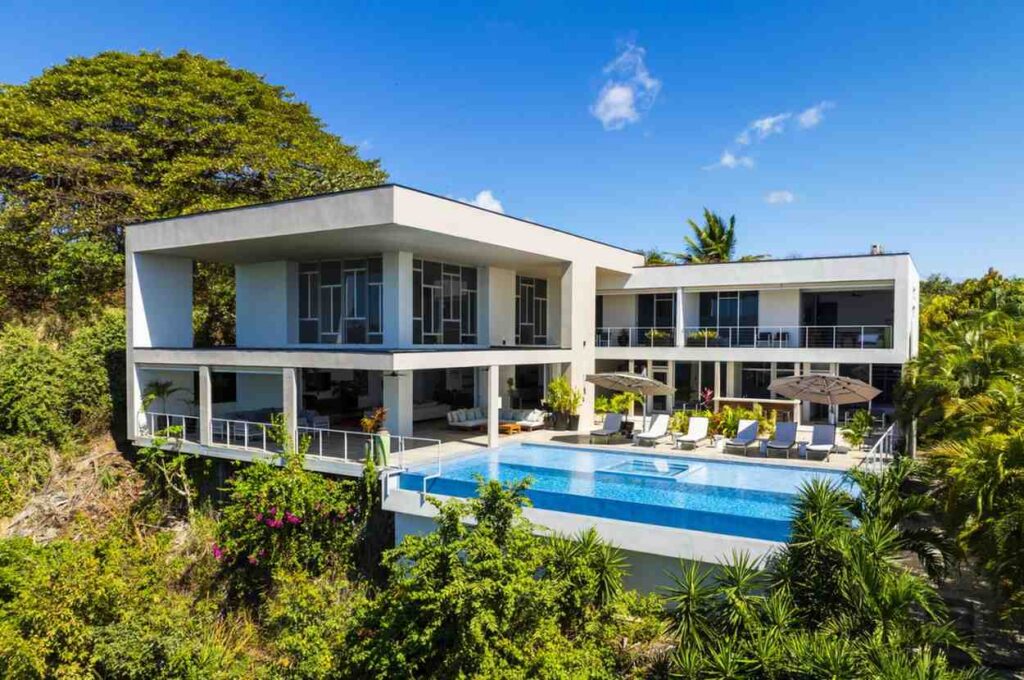
- Single-family homes and villas: from modest houses in residential neighborhoods to custom-built luxury villas with private pools
- Raw land and building lots: available in both titled fee-simple and concession form, with important distinctions that determine what you can build and how you hold title
- Commercial properties and mixed-use buildings: boutique hotels, small businesses, and live-work properties that appeal to investors with an entrepreneurial angle
Each type carries different management requirements, legal considerations, and ownership structures. A condo in a managed resort community is a fundamentally different ownership experience than a standalone villa on a hilltop lot. Not better or worse, but meaningfully different in what it demands of you as an absent owner.
Honest Price Segmentation: From Under $200K to Luxury Villas Above $1M
The honest price map looks roughly like this:
- Under $200K: entry-level condos in Coco, small homes in Liberia, and raw land in less-developed corridors. Expect trade-offs in finish quality, location, or both.
- $200K to $500K: the most active segment of the market, capturing solid two- and three-bedroom condos in gated communities, mid-range homes near the beach, and well-located lots with mountain or ocean views.
- $500K to $1M: quality single-family homes with pools in established communities, premium condos in resort developments, and small luxury villas.
- Above $1M: custom oceanfront and ocean-view estates, high-end Papagayo community properties, and fully turnkey luxury villas with established rental history.
Can You Really Buy a House in Costa Rica for $50,000? An Honest Answer
Yes, technically. You can find properties listed below $100,000 in rural Guanacaste, inland communities, and undeveloped areas. What those listings rarely disclose upfront is why the price is that low: unclear title, concession complications, structural issues, no road access, or location in an area with no rental demand and limited resale market. A $50,000 property that requires $80,000 in legal fees, construction, and infrastructure to make habitable is not a deal. The buyers who get burned in Costa Rica most frequently are the ones chasing anomalously low prices without the local expertise to understand what they are actually buying.
Sub-Market and Property Type Decision Matrix
Use this reference to match your priorities to the right Guanacaste market before you browse a single listing.
| Priority | Papagayo | Playas del Coco | Liberia | Nicoya (Nosara) |
|---|---|---|---|---|
| Budget entry point | $600K+ | $150K | $120K | $300K |
| Walkable town center | No | Yes | Yes | Limited |
| Expat social community | Gated/private | Strong | Growing | Established niche |
| Vacation rental yield | High gross, high overhead | Consistent, lower overhead | Low tourist demand | High seasonal, remote mgmt |
| Road access quality | Excellent | Excellent | Excellent | Variable to poor |
| Airport proximity | 20 min | 35 min | 10 min | 60-90 min + ferry |
| Fee-simple title available | Yes | Yes | Yes | Yes, with exceptions |
| Lifestyle pace | Resort | Relaxed community | Urban | Nature-immersive |
| Best fit buyer | Luxury investor / privacy seeker | Retiree / remote worker | Full-time expat / practical buyer | Wellness / surf / ecology buyer |
A note on rental intent: Papagayo delivers the highest gross rental rates in Guanacaste, but HOA fees, property management costs, and maintenance overhead in premium resort communities compress net yields significantly. Playas del Coco properties in the $250K to $450K range frequently produce cleaner net yields precisely because operating costs are lower. If rental income is central to your financial model, your agent should be running net yield projections, not gross figures.
The Foreign Buyer’s Legal Roadmap: Ownership Rights, Title Protection, and How Closing Actually Works
Your Constitutional Right: How Foreign Ownership Parity Works in Costa Rica
Article 45 of the Costa Rican Constitution guarantees property rights, and the country’s civil code extends those rights to foreign nationals on equal terms with citizens. You can own property outright in your personal name, with no requirement to partner with a Costa Rican national and no cap on the percentage of a property you can own. This is not universal in Latin America. It is one of the features that has made Costa Rica a preferred destination for foreign real estate investment for three decades.
The practical implication is that a US, Canadian, or European buyer has the same legal standing in a Costa Rican property dispute as a Costa Rican citizen. The courts, the National Registry, and the closing process all treat you identically. What varies is your familiarity with the system, which is exactly where a deeply embedded local partner becomes the equalizer.
Is It Safe for Foreigners to Buy Property in Costa Rica? How the National Registry Protects You
The National Registry (Registro Nacional) is the spine of Costa Rican property law. Every titled property in the country has a folio real, a unique registration number, that records ownership, liens, mortgages, easements, encumbrances, and legal annotations in a publicly searchable database. When your attorney conducts a title search, they are pulling the complete recorded history of that folio real and verifying that the seller has clean, unencumbered ownership to transfer.
The system works. Properties with clear title that have been properly recorded carry very low fraud risk because any lien or competing claim must appear in the Registry to be enforceable. The risk is not the Registry itself. The risk is buying a property where title is unclear, where a lien was recorded and never released, or where the property has been subdivided informally without registry updates. A qualified attorney finds these problems before closing, not after. That distinction is everything.
The Maritime Zone: Why Concession Land Requires a Different Conversation
Costa Rica’s Maritime Zone Law reserves the first 200 meters from the high-tide line as public land. The first 50 meters are inalienable public property, meaning no private ownership is possible. The next 150 meters, known as the restricted zone or zona marítima, can be held under a concession granted by the relevant municipality. A concession is not the same as fee-simple title. Concession holders have the right to use and develop the land under terms set by the municipality, but that right can be renewed, restricted, or lost in ways that fee-simple title cannot.
Many of Guanacaste’s most desirable beach-access properties sit in or adjacent to the maritime zone. This is not automatically a dealbreaker. Many concessions are well-established, properly documented, and have long track records of renewal. But it changes the conversation around financing, since most lenders will not mortgage concession land, as well as long-term security and transferability. Your attorney needs to review the specific concession terms before you make any offer on a property near the beach.
The Role of a Qualified Costa Rican Attorney: Non-Negotiable, Not Optional
In Costa Rica, a licensed notary-attorney (notario público) is required to execute property transfers. This is not a formality. The attorney drafts the purchase-sale agreement, conducts the title search, prepares the transfer deed, and records the transaction in the National Registry. Choosing your own attorney, independent of the seller and the brokerage, is the single most important protective step a foreign buyer can take.
Do not use an attorney recommended exclusively by the seller or a developer with a financial interest in the closing. The representation conflict is real. A good buyer’s attorney typically costs $1,500 to $3,000 for a standard residential transaction and provides protection worth multiples of that fee.
Title Search, Escrow, and the 30 to 90 Day Closing Timeline
A standard Costa Rican residential closing moves through these phases:
- Offer and acceptance: the buyer submits an offer, typically with a 10% deposit held in escrow upon acceptance.
- Attorney engagement: the buyer retains independent legal counsel.
- Title search and due diligence: the attorney reviews the National Registry, confirms no liens or encumbrances, verifies the seller’s legal authority to sell, and checks for any pending municipal issues.
- Purchase-sale agreement: a formal contract in Spanish, with translation available, sets the closing date, conditions, and terms.
- Deed preparation and signing: both parties, or their authorized representatives via power of attorney, sign before a notary.
- Registry recording: the transfer deed is recorded in the National Registry, completing the transfer of ownership.
The timeline from accepted offer to recorded title typically runs 30 to 90 days, depending on due diligence complexity, financing arrangements, and registry processing times. Cash transactions close faster. Transactions involving concession land or corporate structures require more time.
Personal Name vs. S.A. Corporation: Choosing the Right Holding Structure
Costa Rican law allows foreign buyers to hold property either in their personal name or through a Costa Rican corporation, most commonly a Sociedad Anónima (S.A.) or Sociedad de Responsabilidad Limitada (S.R.L.). Each structure has real trade-offs.
Personal name ownership is simpler, less expensive to maintain, and perfectly appropriate for many buyers, particularly those buying a primary residence or a single property they plan to hold long-term. Corporate ownership can provide liability separation, simplified transfer through a share sale rather than re-recording the deed, and potential estate planning advantages. However, it requires annual corporate filings and a nominal corporate tax.
The right answer depends on your intended use, your US tax situation, whether you plan to rent the property commercially, and your estate planning goals. This is a conversation for your attorney and, if you are a US citizen, your US-based tax advisor, because Costa Rican corporate structures have FBAR and FATCA reporting implications that catch many buyers by surprise.
Common Mistakes Foreign Buyers Make and the Due Diligence Steps That Prevent Them
The most costly mistakes in Guanacaste real estate share a common thread: buyers skipped a step because they trusted the wrong person or felt social pressure to move quickly. The specific forms those mistakes take:
- Paying a deposit directly to a seller or developer without independent escrow
- Purchasing without an independent title search, relying instead on assurances from the seller’s agent
- Buying concession land without understanding the renewal terms or municipal standing
- Failing to verify that a property matches its registered survey (plano catastrado), since boundary disputes are common when survey records are old or informal
- Ignoring HOA financial health, since buying into a community where the reserve fund is depleted means inheriting deferred maintenance liability
- Wiring funds internationally without confirming banking instructions through a verified channel separate from email
The prevention is not complicated: hire your own attorney, use a licensed escrow service, and work with a local agent who has enough stake in the market to care about your outcome years after closing.
The True Cost of Owning a Home in Guanacaste: The Complete Picture
Property Taxes in Costa Rica: Why the Numbers Will Surprise You
Costa Rica’s annual property tax (impuesto sobre bienes inmuebles) is 0.25% of the registered property value, among the lowest rates in the hemisphere. On a $350,000 property, that is $875 per year. On a $700,000 villa, approximately $1,750 per year. There is also a luxury home tax (contribución especial solidaria) that applies to residential properties with a construction value above a threshold adjusted periodically by the government. The luxury tax rate is progressive and adds a modest additional annual charge for higher-value homes, but even at the upper end of the residential market, total annual property tax obligations remain a fraction of what US buyers pay in most states.
The registered value and the market value are not always the same. Properties have historically been registered at lower values for tax purposes, but the municipality can request reappraisal, and buyers who pay market price will eventually see their registered value move toward purchase price. Work with your attorney to understand the current registered value and what trajectory to expect.
Transfer Taxes, Closing Costs, and What to Budget at Purchase
Beyond the purchase price, plan for these one-time closing costs:
- Transfer tax: 1.5% of the registered property value, paid to the government
- Documentary stamps and registry fees: approximately 0.5% to 0.6% of the registered value
- Attorney fees: typically 1% to 1.5% of the purchase price
- Escrow fees: typically $500 to $1,500 depending on the provider and transaction size
- Independent title insurance: optional but available through international providers, typically 0.5% to 1% of purchase price
Total closing costs for a buyer commonly run 3% to 4% of the purchase price. On a $400,000 property, budget $12,000 to $16,000 in closing costs above the purchase price.
HOA and COA Fees: What They Cover and Why Financial Health Matters
HOA and COA fees in Guanacaste vary enormously by community type. A modest gated community in Playas del Coco might charge $150 to $300 per month for road maintenance, security, and common area upkeep. A full-amenity resort community in Papagayo might charge $800 to $2,000 per month and cover beach club access, landscaping, concierge services, and 24-hour security.
What fees cover matters less than whether the association is solvent. Request the HOA’s audited financials and reserve fund balance before closing. An HOA with a depleted reserve fund and deferred maintenance on roads, pools, or security infrastructure will assess special fees to cover those costs, and as a new owner, you inherit that liability. This is one of the most consistently overlooked risks in foreign buyer due diligence, and it is entirely preventable with the right questions asked before closing.
Property Insurance, Utilities, and Maintenance Reserves: Building Your Real Annual Budget
Property insurance in Guanacaste runs roughly 0.4% to 0.8% of replacement value annually for a standard residential policy covering structure, contents, and liability. On a $350,000 home, budget $1,400 to $2,800 per year. Policies from the state insurer INS and from international providers are both available.
Utilities for a part-time or rental property typically include electricity (higher in Guanacaste due to air conditioning demand, ranging from $100 to $400 per month depending on usage), water, and internet.
Maintenance reserves are where most foreign buyers underestimate their costs. A pool requires weekly chemical treatment and periodic equipment replacement. Tropical climate accelerates wear on paint, roofing, and appliances. Landscaping in the green season grows faster than most buyers expect. A reasonable maintenance reserve for a $350,000 condo is $3,000 to $5,000 per year. For a $700,000 standalone villa with a pool and large garden, budget $8,000 to $15,000 annually depending on condition and usage.
Illustrative Annual Cost Models: $350K Condo vs. $700K Villa
These figures are illustrative ranges based on typical Guanacaste market conditions, not guarantees.
$350,000 Condo in a Managed Community (Playas del Coco area)
- Property tax: $875
- HOA/COA fees: $2,400 to $4,800 (at $200 to $400/month)
- Property insurance: $1,400 to $2,100
- Utilities (electric, water, internet): $2,400 to $4,800
- Maintenance reserve: $3,000 to $5,000
- Total annual carrying cost: $10,075 to $17,675
$700,000 Villa in a Gated Community (Papagayo area)
- Property tax: $1,750, plus a potential luxury tax supplement of $500 to $1,500
- HOA fees: $9,600 to $24,000 (at $800 to $2,000/month)
- Property insurance: $2,800 to $5,600
- Utilities: $4,800 to $9,600
- Maintenance reserve: $8,000 to $15,000
- Total annual carrying cost: $26,950 to $55,750
These numbers are before property management fees if you plan to rent the property. Professional vacation rental management in Guanacaste typically costs 20% to 30% of gross rental revenue. An honest investment analysis accounts for all of these costs before calculating net yield. Any advisor who shows you gross revenue projections without walking you through this full cost picture is not giving you the information you need to make a sound decision.
Choosing the Right Neighborhood for Your Lifestyle and Investment Goals
The Questions to Ask Before You Fall in Love With a Listing
Most buyers find a listing they love and then try to make the neighborhood fit. The smarter sequence runs in reverse. Before you scroll a single property, answer four questions honestly: How often will you actually be there? Do you want to walk to a coffee shop or restaurant, or are you comfortable driving everywhere? Is rental income a financial necessity or a nice-to-have? And how much management complexity are you willing to absorb from a distance?
Your answers will eliminate two or three sub-markets immediately and concentrate your search on the inventory that can actually deliver the outcome you want. A buyer who needs community walkability and a rental income stream to cover costs is looking at Playas del Coco, not Papagayo. A buyer who wants privacy, resort amenities, and premium short-term rental rates and can absorb high HOA overhead is looking at the opposite. The listing comes after the fit, not before.
Walkability, Social Scene, and Expat Community Integration
Playas del Coco remains the Gold Coast’s most naturally walkable community. The town center has a beach, a plaza, grocery options, restaurants, dive operators, and a rotation of expat social events within a few blocks. Retirees and remote workers who value community density consistently rate Coco’s social integration as one of the easiest in Guanacaste. Flamingo and Tamarindo offer similar walkable beach-town energy with slightly different demographic mixes.
Papagayo communities are a different model: gated, resort-oriented, and privately contained. The social life exists, but it is built around amenity spaces within the community rather than a public town center. Buyers who thrive there typically want controlled access and resort-level service over organic neighborhood interaction.
For buyers who plan to live in Guanacaste year-round, community fit matters as much as the property itself. The expat network here is genuinely warm, but it is not uniform. Spend time in the neighborhoods you are considering before you make an offer, not after.
Healthcare Access, Road Quality, and Airport Proximity
The earlier section on healthcare covered the regional picture. What deserves emphasis here is how dramatically location within Guanacaste affects your practical access to that care. CIMA Guanacaste in Liberia is roughly 35 minutes from Playas del Coco and 20 minutes from Papagayo on paved highway. Nosara on the Nicoya Peninsula can be 90 minutes or more depending on road conditions, with several unpaved stretches that become genuinely difficult in wet season.
Road quality varies sharply between communities. The main coastal highway and the roads connecting Papagayo and Coco to Liberia are well-maintained. Secondary roads inside residential communities range from smooth paved access to rutted gravel that requires a four-wheel-drive vehicle. If you have mobility considerations or are purchasing for older family members, road access belongs in your due diligence list alongside title and HOA financials.
LIR proximity is a real lifestyle variable. A short drive from your property to direct flights home changes absentee ownership from a logistical challenge to a manageable routine. Properties farther from the airport are not disqualified, but the math on frequent visits shifts noticeably.
What the Cost of Living and Lifestyle Are Actually Like for Expats on the Gold Coast
Guanacaste is not cheap by Latin American standards, but it remains meaningfully more affordable than coastal living in the United States. A couple living comfortably in Playas del Coco without a mortgage typically spends $2,500 to $4,000 per month covering groceries, dining, transportation, utilities, health insurance, and activities. Papagayo living, with higher utility costs and access to resort-priced amenities, runs closer to $4,500 to $7,000 for a similar lifestyle.
Groceries split along two tracks. Local markets and the farmers market in Coco offer produce, fresh fish, and staples at prices well below US levels. Imported goods at larger supermarkets carry prices comparable to or above US equivalents. Most long-term expats learn to cook with local ingredients and reserve the imports for occasional use.
Dining out ranges from $8 to $15 per person at a solid local restaurant to $40 to $80 at upscale spots in resort communities. Healthcare is dramatically less expensive than in North America. The lifestyle itself, with beach access, warm weather, and a slower pace, is widely described by long-term residents as worth more than the savings alone.
Matching Your Neighborhood to Your Primary Goal: Personal Use, Rental Income, or Both
Personal-use buyers should prioritize lifestyle fit and long-term livability. That often means choosing a community with active social infrastructure, walkable amenities, and road quality that supports daily life year-round, even in wet season.
Rental income buyers need to follow the demand data. Strong short-term rental performance in Guanacaste clusters around beach proximity, resort amenity access, and brand-name community recognition. Papagayo and the immediate Coco area command the most consistent occupancy. Properties in inland or rural corridors may have lower purchase prices but carry limited rental demand outside niche markets.
Hybrid buyers, those planning to use the property personally during the high season and rent it the rest of the year, face the trickiest optimization. The best hybrid properties are in communities that allow short-term rentals (not all do), carry low enough operating costs to remain profitable at moderate occupancy, and offer the quality of finish and furnishing that vacation renters expect. This is exactly where local knowledge about specific community rental rules and HOA restrictions saves buyers from expensive surprises.
Vacation Rental Potential and Realistic Yields in Guanacaste
Average Rental Yields on Vacation Properties in Guanacaste
Gross rental yields on short-term vacation properties in Guanacaste typically range from 6% to 12% of purchase price annually, depending on location, property type, and how well the property is managed. A two-bedroom condo near Playas del Coco purchased for $300,000 and renting for $150 to $200 per night can generate $25,000 to $40,000 in gross annual revenue at reasonable occupancy. A three-bedroom villa in Papagayo at $800,000 may rent for $500 to $800 per night but will also carry far higher operating costs.
These gross figures circulate widely on listing platforms and investment pitches. They are a starting point, not a conclusion.
Gross vs. Net Yield: The Number That Actually Matters
Net yield is what remains after you subtract every cost of ownership and operation from gross rental revenue. For a Guanacaste vacation rental, those costs include property management fees (20% to 30% of gross revenue), HOA and COA fees, property taxes, insurance, utilities, maintenance and repairs, platform listing fees, and any accounting or legal costs. The gap between gross and net is typically 40% to 60% of gross revenue.
On the Coco condo example above generating $35,000 gross: after a 25% management fee, $4,800 in HOA fees, $875 in taxes, $2,000 in insurance and utilities, and $3,000 in maintenance, net revenue lands around $18,000 to $21,000. That is a net yield of roughly 6% to 7% on a $300,000 investment, which is a genuinely solid return. Presenting the $35,000 gross figure as your financial reality is not honest advising. Any partner worth working with will show you both numbers, clearly and without prompting.
Why Operational Quality Determines Whether Your Rental Performs
Two identical condos in the same building with the same nightly rate and the same listing platform can produce dramatically different results. The difference is almost always operational: how fast inquiries are answered, how competitively rates are adjusted for seasonality and demand, how consistently the property is cleaned and photographed, and how quickly maintenance issues are resolved between guest stays.
Guanacaste’s high season runs December through April. Occupancy during those months can reach 80% to 90% for well-run properties. Green season occupancy for poorly managed properties drops sharply. For professionally managed properties with active rate management and repeat guest strategies, green season occupancy often holds at 40% to 60%. That difference in shoulder-season performance is the margin between a property that covers its costs and one that drains the owner.
Can You Manage a Rental Property in Guanacaste from the USA?
Technically yes. Practically, it is a significant underestimate of what active rental management requires. Responding to guest inquiries across time zones, coordinating same-day cleanings, dispatching a repair crew when the air conditioner fails on a Friday afternoon, and adjusting pricing during a competitor’s promotional period are not tasks you can manage reliably from two thousand miles away, even with the best intentions.
Some owners try it for a season and discover that the carrying cost of one bad guest experience, a negative review, a maintenance issue that went unresolved, a booking that fell through because the inquiry sat in an inbox for six hours, exceeds the management fee they were trying to avoid.
What a Professional Management Partner Does That a Remote Owner Cannot
A qualified local property management firm brings the infrastructure a solo remote owner cannot replicate: vendor relationships built over years that produce faster response and fairer pricing, housekeeping teams calibrated to rental turnover standards, pricing tools that adjust nightly rates in response to real-time demand signals, and a guest services capability that protects your reviews and your repeat business.
More than the operational pieces, a good management partner provides ongoing information. You learn when your AC unit is approaching end of life before it fails during a peak booking. You find out when the HOA is considering a special assessment before it hits. You know what comparable properties are charging and how your occupancy benchmarks against them. That information flow is what separates passive property ownership from managed investment performance, and it is something a remote owner simply cannot replicate on their own.
Why Your Local Partner Matters More Than the Listing Platform You Browse
What Aggregator Platforms and Listing Databases Cannot Tell You
A listing database will show you price, square footage, bedroom count, and whatever photos the listing agent chose to upload. It will not tell you that the HOA has deferred road maintenance for two years. It will not tell you that the community has a no-short-term-rental policy that the listing description quietly omits. It will not tell you that a nearly identical property two streets over sold for 12% less three months ago because the seller was motivated, and that the current listing is priced above where the market is actually trading.
These are not edge cases. They are the standard information gap between what a listing presents and what you need to know to make a sound decision. Closing that gap requires someone with on-the-ground knowledge, an existing relationship with other agents and sellers, and a genuine investment in your outcome rather than the fastest possible transaction.
Off-Market Inventory and the Network Access That Aggregators Cannot Provide
A meaningful portion of Guanacaste real estate transacts before it ever reaches a listing platform. Sellers who have worked with a firm for years make a call before they list publicly. Developers pre-sell units to agent networks before launch. Estates and motivated sellers often prefer a quiet transaction to the exposure of a public listing. A buyer working exclusively from aggregator searches has no access to any of this inventory.
A locally embedded firm hears about these opportunities because it has spent years building relationships with other professionals in the market, not just maintaining a database subscription. For buyers with specific criteria, a particular community, a particular view corridor, a specific price point, that network access can be the difference between finding the right property and settling for whatever happened to be publicly listed.
How a Relationship-Based Firm Protects You Where a Transaction-Focused Agent Cannot
A transaction-focused agent’s incentive structure ends at closing. Commission is paid, the file closes, and their attention moves to the next buyer. A relationship-based firm’s incentive structure extends well past closing, because their reputation, their referrals, and their ongoing management business all depend on whether your property performs and whether you are satisfied a year, three years, and ten years after you signed.
That structural difference produces different behavior in the moments that matter. A relationship-based advisor will tell you when a property’s HOA financials look worrying, even if that kills a deal. They will push back on a seller’s asking price when the comparables do not support it. They will flag the concession complication rather than minimize it. These conversations happen because the firm’s interest and your interest are genuinely aligned, not because the agent is unusually principled.
What Nearly Two Decades in This Specific Market Actually Means for Your Outcome
Experience in one market for close to two decades produces something that broad geographic coverage cannot: pattern recognition. A firm that has operated continuously on the Gold Coast has watched communities develop from raw land to mature neighborhoods. It has seen which HOAs maintained their financial health through market cycles and which ones did not. It has tracked how specific road corridors developed, which view lots appreciated, and which community promises from developers materialized.
That institutional memory shapes every recommendation. When a buyer asks whether a particular community is a good fit for vacation rental income, the answer comes from having managed properties there for years, not from reading the same listing description the buyer already saw.
Vetted Attorney Networks, HOA Intelligence, and the Due Diligence Infrastructure Behind the Sale
The due diligence on a Guanacaste property purchase is only as strong as the professionals executing it. A referral to a qualified independent attorney from a firm with an established reputation carries weight that a cold inquiry does not. The attorney knows that their relationship with the firm depends on giving buyers complete, honest counsel, which aligns their incentives correctly.
The same logic applies to HOA intelligence. A firm managing properties inside a given community for years has access to informal knowledge that no title search captures: which board members are active, which pending assessments are being discussed, which maintenance issues have been deferred. That information belongs in your decision, and it only exists in the hands of someone who has been inside that community continuously.
Protecting Your Investment After Closing: The Post-Purchase Lifecycle
The Absentee Owner’s Real Problem, and Why It Starts the Day After Closing
The day after closing, you are the owner of a property in a country where you likely do not live, in a language you may not speak, managed through a legal and municipal system you have just begun to understand. The transaction expertise that got you to closing does not automatically extend into what comes next.
The absentee owner’s practical problem is not that Costa Rica is difficult. It is that distance compresses small problems into expensive ones. A roof gutter that needs clearing becomes a water intrusion issue if no one notices it for six months. A guest complaint about a broken appliance becomes a negative review if there is no one to dispatch a repair within hours. A municipal notification about a property boundary question gets missed entirely if there is no one on the ground to receive it. The right post-purchase partner eliminates all of these failure points. They are the reason your investment remains an asset rather than becoming a liability.
Routine Maintenance Coordination and Vendor Management
Effective remote ownership requires a trusted local vendor network, a reliable inspection schedule, and someone who holds those relationships accountable. Pool maintenance, landscaping, pest control, and periodic property inspections are all services that exist in Guanacaste but require active management to perform consistently.
A professional property manager handles vendor scheduling, quality verification, and cost negotiation on your behalf. They know which contractors deliver reliable work at fair prices, and they have the leverage of ongoing business relationships to ensure accountability. The alternative, managing vendors individually from abroad, is a project management burden that consumes far more time than most buyers anticipate.
Vacation Rental Marketing, Guest Services, and Pricing Strategy
Vacation rental performance is not passive. It requires active listing management across booking platforms, professional photography updated periodically, pricing adjustments in response to demand signals and competitor behavior, and guest communication from inquiry through checkout. A property that was well-positioned two years ago may have slipped in search rankings simply because its listing was not maintained.
Guest experience management also requires local presence. Pre-arrival communication, check-in coordination, in-stay support for questions or issues, and post-stay review management all determine whether guests rebook, refer others, and leave five-star reviews. These are not tasks that scale well from a US time zone.
HOA and COA Representation for Foreign-Owned Properties
HOA matters, including meetings, votes on special assessments, disputes with the board, and changes to community rules, proceed on Costa Rican time regardless of where you are. A foreign owner who is not represented locally often finds out about board decisions after they have been ratified and implemented.
A property management firm with standing relationships inside your community can attend meetings as your representative, flag issues before they become votes, and ensure that your property and your interests are represented in the community governance process. For owners in communities where short-term rental policies, renovation approvals, or assessment decisions are active topics, this representation is the difference between being a party to decisions that affect your investment and being surprised by them.
Annual Reporting, Financial Oversight, and Staying Informed Without Being On-Site
Costa Rican property ownership carries ongoing obligations: annual corporate filings if you hold the property in an S.A., municipal tax declarations, rental income reporting requirements, and CAJA obligations if you employ domestic staff. Missing these filings can result in penalties, loss of corporate good standing, or complications with property records.
A full-service management partner maintains a compliance calendar, coordinates with your Costa Rican attorney on filing deadlines, and delivers regular financial reporting that keeps you informed without requiring you to chase information. Monthly statements covering rental income, occupancy, maintenance expenditures, and reserve balances give you a real-time picture of your investment’s performance, the same oversight you would exercise if you lived next door.
Quick-Match Guide: Which Post-Purchase Service Tier Fits Your Ownership Profile
Personal-Use Absentee Owner
You visit seasonally and keep the property closed the rest of the year. You are not renting to guests.
Core needs: property inspections, routine maintenance coordination, utility and HOA payment oversight, security monitoring. The right fit is a basic property caretaking program with scheduled inspections and a single point of contact for urgent issues.
Active Vacation Rental Investor
The property needs to earn income. Occupancy, nightly rate, and net yield matter to your financial plan.
Core needs: full-service rental management including listing management, pricing strategy, guest services, housekeeping coordination, and monthly financial reporting. You also need HOA representation to protect rental permissions, compliance oversight for corporate and tax filings, and maintenance vendor management between bookings. The right fit is a full-service management partnership with a transparent fee structure and verifiable performance reporting.
Hybrid Lifestyle Buyer
You use the property personally during peak season and rent it the rest of the year.
Core needs: a rental program that works around your personal use calendar, flexible booking management that blocks your dates while maximizing surrounding availability, and property transition service between personal and rental use. You also need clear communication about how your personal-use period affects annual revenue projections. The right fit is a hybrid management program with personal-use calendar integration and a manager who treats your lifestyle goals as equal to your income goals.
Your Next Step Toward a Confident, Protected Purchase in Guanacaste
What This Guide Has Equipped You to Do Differently Than Most Foreign Buyers
Most buyers searching for Guanacaste Costa Rica homes for sale arrive at listing platforms, filter by price and bedrooms, and start building their mental wishlist before they understand what they are actually navigating. This guide was built to interrupt that sequence in the most useful way possible, by giving you the context to evaluate what you see, not just to see it.
You now know which sub-market fits your lifestyle and financial goals before you browse a single listing. You understand that closing costs, HOA fees, maintenance reserves, and property management fees are as central to your investment math as the purchase price. You know the difference between a concession property and a fee-simple title, and why that distinction belongs in your first conversation with an attorney rather than your last. You know what gross yield means and what net yield is, and you know never to make a financial decision based only on the first number.
That is a meaningfully different position than the one most foreign buyers occupy when they start this process.
The One Decision That Will Shape Every Other Decision You Make
Every protective mechanism available to a foreign buyer in Guanacaste, independent legal counsel, thorough due diligence, off-market access, HOA intelligence, and post-purchase management, flows from one decision: who you choose as your local partner. That choice is not the same as choosing a listing platform or a search filter. It is a choice about who will be accountable to you across the entire lifecycle of the transaction and beyond.
A firm that has operated on the Gold Coast for nearly two decades, that manages properties in the communities it recommends, that maintains vetted attorney relationships and deep HOA knowledge, and that earns its reputation through long-term client outcomes is a fundamentally different resource than an agent who is compensated to close a transaction. The distinction is worth taking seriously before you fall in love with a listing and find yourself moving too fast through a process that rewards patience and local knowledge at every step.
How to Start a Conversation That Puts Your Interests at the Center
The right first conversation is not about a specific listing. It is about your situation: what you are hoping to accomplish, what your timeline looks like, what financial parameters you are working within, and what concerns keep you up at night about buying property abroad. A partner worth working with will want to understand all of that before they show you a single property.
If you are ready to move from research to that kind of conversation, reach out directly. There is no pressure to have all your answers ready, and there is no sales process waiting on the other side. There is just an experienced team on the ground in Guanacaste that has helped buyers like you, buyers who did their homework, asked the right questions, and wanted a partner rather than a transaction, find, purchase, and protect properties that delivered exactly what they hoped for.
The property is waiting. The conditions are favorable. The framework you need to move confidently is now in your hands.
Frequently Asked Questions
Is it safe for foreigners to buy property in Costa Rica, and how are titles protected?
Yes, buying property in Costa Rica as a foreigner is safe when you work with qualified professionals. Every titled property is registered in the National Registry (Registro Nacional), a public database that records ownership, liens, and encumbrances. A licensed Costa Rican attorney conducts a thorough title search before closing, confirming the seller has clean, transferable ownership. The risk is not the system itself; it is skipping the due diligence steps that the system is designed to support.
What are the real costs of owning a home in Guanacaste beyond the purchase price?
Annual carrying costs typically include property tax (0.25% of registered value), HOA or COA fees ($150 to $2,000 per month depending on community type), property insurance (roughly 0.4% to 0.8% of replacement value), utilities, and a maintenance reserve. For a $350,000 condo, total annual carrying costs often run $10,000 to $17,000. For a $700,000 villa, that range can reach $27,000 to $55,000 before any property management fees. Closing costs at purchase add another 3% to 4% of the purchase price.
How long does it take to buy a house in Costa Rica, and what is the legal process?
A standard residential closing in Costa Rica takes 30 to 90 days from accepted offer to recorded title. The process moves through offer and deposit, attorney engagement, title search and due diligence, purchase-sale agreement, deed signing before a notary, and final recording in the National Registry. Cash transactions close faster. Deals involving concession land, corporate structures, or complex financing require more time. A qualified buyer’s attorney guides every step.
What are common mistakes foreign buyers make when purchasing Costa Rican real estate?
The most common mistakes include paying deposits without independent escrow, purchasing without an independent title search, buying concession land without reviewing the specific renewal terms, failing to verify that a property’s physical boundaries match its registered survey, and ignoring HOA financial health before closing. Buyers who rely solely on the seller’s agent for guidance, or who rush due diligence under social pressure, are the ones most frequently burned. Working with your own attorney and a locally embedded agent with no interest in a fast close is the most reliable protection.
Can I manage a rental property in Guanacaste from the USA, and how do I find a trustworthy manager?
Managing a vacation rental remotely is technically possible but practically very difficult to do well. Responding to guest inquiries across time zones, coordinating same-day turnovers, and dispatching repairs quickly enough to protect reviews all require local presence. A trustworthy local property manager brings established vendor relationships, pricing tools calibrated to real-time demand, and the infrastructure to handle guest services professionally. Look for a firm with verifiable occupancy history in the specific community you are buying into, a transparent fee structure, and a track record of managing properties for absentee owners over multiple years.
Do I need to become a resident of Costa Rica to buy property in Guanacaste?
No. Costa Rica allows any foreign national to purchase and hold titled property without residency or a visa. Your passport is sufficient for the transaction. Residency becomes relevant if you plan to spend extended time in the country, since it opens access to the public healthcare system and simplifies long-term banking. Many buyers purchase first and explore residency options afterward, and the property itself may qualify as part of an Inversionista residency application depending on the purchase price.
How do property taxes and HOA fees work for foreign-owned homes in Costa Rica?
Costa Rica’s annual property tax is 0.25% of the registered property value, making it one of the lowest in the hemisphere. A $400,000 home carries approximately $1,000 per year in property tax. HOA fees vary widely: a modest gated community in Playas del Coco might charge $150 to $300 per month, while a full-amenity resort community in Papagayo can charge $800 to $2,000 per month. Before buying into any community, request the HOA’s audited financials and reserve fund balance. A depleted reserve fund means potential special assessments that new owners inherit.